Last reviewed: November 25, 2026
In this article
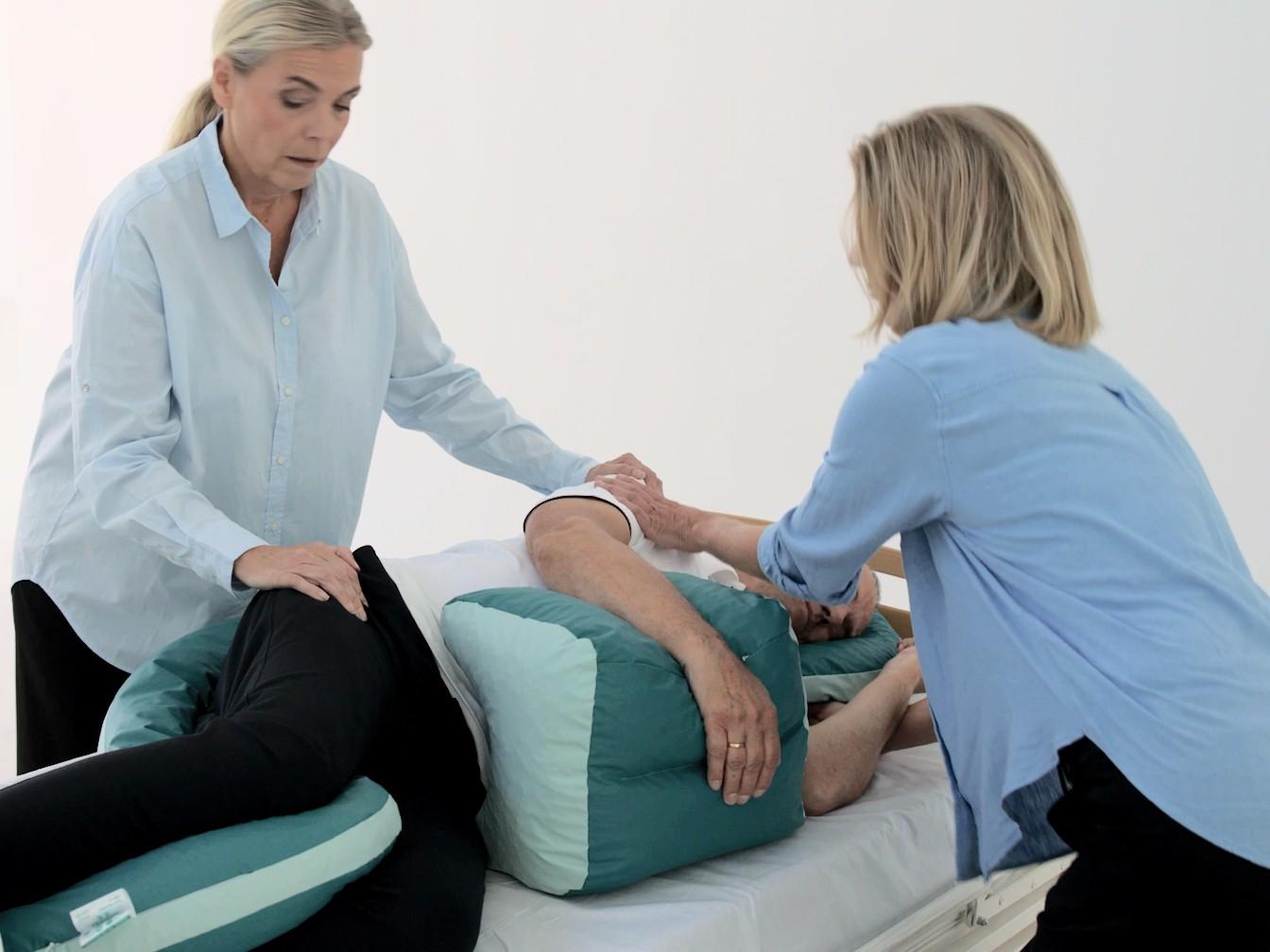
Repositioning sets the position, and the support has to hold it until the next repositioning. When standard pillows are used, check whether they continue to support the planned position. Positioning cushions are supports placed around selected parts of the body to help maintain the position agreed in the care plan. They work alongside the mattress. This article is about the residents for whom a pillow isn’t enough: how to spot them at the bedside, what the research has measured, and how to trial purpose-designed positioning cushions.
The International Guideline advises using positioning devices to help maintain the 30-degree lateral position. [1] One of the two studies it cites for that advice measured how well a pillow holds the position over two hours. [2]
27° → 17°
Average side-lying angle on standard pillows, at the start and two hours later · 12 aged-care residents positioned toward a 30° tilt
With the tested positioner, the same residents’ average angle went from 31° to 27° over the same two hours.
Kapp et al., Int Wound J 2019 [2]
A 30-second read
Clinical takeaways
International Guideline 2026 · Kapp 2019
Check that the position holds.
At the next repositioning, is the resident still in the planned position? The guideline asks teams to “evaluate the effectiveness of the devices in sustaining the individual’s position.” [1]
Pillows can lose the tilt.
In one study, pillows lost about 10° of side-lying angle in two hours; the tested positioner lost about 4°. [2]
Trial supports that keep their shape.
For residents whose position doesn’t hold, trial purpose-designed cushions. Judge them on position, comfort, skin and tissue, safety, ease of care and staff confidence.
For Directors of Care: on your unit, which residents are found off their planned position at the next repositioning?
Section 1 · The bedside question
After repositioning, does the support hold the intended position?
- International Guideline · Repositioning chapter · 2026
The question is easy to ask at the next repositioning: is the resident still in the position the plan describes? The guideline recognizes that some people are “unable to maintain the 30-degree lateral position for adequate durations.” [1] The clinical team individualizes the angle and checks that the position achieves the intended offloading; some residents may need a modified angle, such as 40°. [1] The guideline also asks teams to choose a device that suits the resident, and to check whether it is “sustaining the individual’s position.” [1]
| What the team finds at the next repositioning | What it suggests |
|---|---|
| The resident has rolled back toward lying flat | Reassess the support, comfort and whether the planned position remains appropriate |
| A pillow has slipped, flattened or moved out from behind the back | The support isn’t keeping its shape or its place |
| The head, trunk or legs have settled into a twisted or collapsed posture | Alignment isn’t supported along the whole body |
| The resident is restless, uncomfortable, or pushes the supports away | Comfort and fit need reassessing |
| The heels are back on the mattress | The heel plan isn’t holding |
Record the current setup and what you observe as the trial baseline. Address pain, skin changes or inadequate support promptly rather than waiting to complete baseline observations.
Section 2 · What the research measured
How long does a pillow hold a 30° tilt?
- Kapp et al. · observational study · 2019
- Cited in the International Guideline · Repositioning, p. 12
A team at the University of Melbourne measured it. Twelve aged-care residents at risk of pressure injuries, average age 83 and immobile in bed, were positioned toward a 30° side-lying tilt under two conditions: with standard care pillows, and with a purpose-designed positioning device. Body angle was measured at the start, after one hour and after two hours, on 10 occasions. [2]
Kapp et al., 2019 · Observational study · 12 aged-care residents
17° vs 27°
Average side-lying angle two hours after positioning toward a 30° target · standard pillow vs the tested positioner
Standard pillow: At the start 26.7° degrees; After 1 hour 21.5° degrees; After 2 hours 16.6° degrees.
Tested positioner: At the start 30.7° degrees; After 1 hour 29.3° degrees; After 2 hours 26.8° degrees.
- Residents
- 12 residents of residential aged care at risk of pressure injuries, average age 83, immobile in bed.
- Design
- Observational. Each resident was positioned with both supports, and body angle was measured at the start, 1 hour and 2 hours on 10 occasions.
- Authors’ conclusion
- “The lateral tilt body position was better maintained with the positioning device than the pillow.”
- Study note
- Measured body angle in 12 aged-care residents. The tested fluidized positioner was not an NG cushion.
Kapp et al., 2019 · International Wound Journal [2]
The International Guideline cites this study, with one other, for its advice on positioning devices. [1][2]
Use positioning devices to assist the individual to maintain the 30-degree lateral position more effectively.
International Guideline, 4th ed. · Repositioning and Mobilization · 2026, p. 12 [1]
Section 3 · Why the planned position matters
Why does the planned position matter?
- van Helden et al. · pressure mapping · 2026
- Osborne et al. · scoping review · 2023
The position decides where the body’s weight falls. The guideline recommends 30° side-lying over 90°, and Getting Started with 24-Hour Positioning sets out its reasons.
A 2026 pressure-mapping study shows the pattern. Fifteen healthy volunteers lay in different positions on two non-powered hospital mattresses, and the authors offer their pressure maps as a way to teach staff how position changes where pressure falls. [3]
Pressure mapping · van Helden et al., 2026
Turning further onto the side, from 30° to 60°, raised the median pressure on the hip (greater trochanter) by 27% to 35%. [3]
15 healthy volunteers on two non-powered hospital mattresses; the authors report the rise as a range across the two.
Position in bed matters beyond the skin, too. A 2023 scoping review notes “growing evidence that supports the notion that positioning in lying has a direct relationship on the success of postural alignment in sitting.” [4]
Section 4 · Where pillows fall short
When is a pillow not enough?
- International Guideline · 2025–2026
- RESNA position paper · 2025
- Wounds Canada · 2025
- Heyneman et al. · comparative trial · 2009
Pillows have a place: the heel chapter, for example, makes pillows or cushions good practice when a heel offloading device isn’t available or doesn’t suit the resident’s activity and mobility. [5] Teams tend to see a pillow’s limits in the same few situations.
Where purpose-designed supports help
Residents of greater weight
The guideline notes that “smaller/less dense pillows and wedges may flatten when used to position individuals of greater weight.” [1]
Fixed or asymmetric postures
For individual body shapes, the guideline suggests “specialist repositioning devices to support the individual’s specific needs/body shape (e.g. fluidized positioners that can be shaped).” [1]
Supports that must stay put
In lying posture care management, RESNA advises: “Large, loose pillows are avoided because they are ineffective and potentially unsafe.” [6]
Heels
Wounds Canada: “Evidence suggests that the use of a wedge-shaped cushion to suspend the heels off the bed is more effective in reducing the incidence of pressure ulcers than the use of a standard pillow.” [7] See Floating the Heels.
Heyneman et al., 2009 · Comparative trial · Patients over 75
10.2% vs 1.9%
Heel pressure ulcers, grades 2–4 · an ordinary pillow vs a wedge-shaped cushion under the lower legs
Pillow 10.2%; Wedge cushion 1.9%.
- Patients
- 162 patients over 75 years of age. All were lying on a viscoelastic foam mattress and were repositioned every 4 hours.
- Design
- A comparative study, indexed by PubMed as a randomized controlled trial: a wedge-shaped, bed-wide viscoelastic foam cushion under the lower legs against an ordinary pillow.
- Authors’ conclusion
- “The study provides evidence that a wedge-shaped, bedwide, viscoelastic foam cushion decreases the risk of developing a heel pressure ulcer compared with the use of a pillow.”
- Study note
- The tested cushion was a bed-wide foam wedge, not an Evergreen product.
Heyneman et al., 2009 · Worldviews on Evidence-Based Nursing [8]
Have a resident in mind?
Use the one-page trial checklist to compare the current setup with a positioning-cushion trial.
Section 5 · Changing needs
When posture or contractures change, reassess the lying support.
- International Guideline · Repositioning chapter · 2026
- Neef et al. · 2026
A setup that held last month may not hold now. The guideline notes that “priorities may change over time and the repositioning regimen should be regularly evaluated.” [1] Contractures are a common reason. In two multicentre studies in Germany, 19.3% of nursing-home residents had at least one contracture. [9]
Reassess the lying support when
The body changes
- Posture changes, or a contracture develops or progresses
- Tone, spasticity or weight changes
- Mobility declines or improves
Skin, comfort or goals change
- New skin changes, pain or a new injury appear
- Comfort or sleep gets worse
- Goals of care change
Fixed postures also concentrate load on fewer sites and make offloading harder. That is why postural changes and contractures are among the presentations that prompt a support-surface assessment in Who Should Be Considered for a Powered Support Surface? Reassess the mattress and the positioning supports together.
Section 6 · Run a trial
How do we trial positioning cushions on our unit?
- Evergreen trial checklist
Start with the residents whose position didn’t hold, and compare the new setup with the baseline you recorded. The clinical team sets the trial length. Check skin, comfort and safety before extending use. Put the agreed setup in the bedside plan, with a photograph where the home’s consent and privacy procedures allow. Record the setup and consent in the plan of care, and follow the home’s least-restraint policy and provincial requirements.
| Check | What to look for |
|---|---|
| Position held | At the next repositioning, is the resident still in the planned position? Compare with the baseline. |
| Supports in place | Have the cushions stayed where they were placed, and kept their shape? |
| Comfort and pain | Ask the resident about comfort and pain before and after positioning. If the resident can’t reliably report pain, use the home’s observational pain tool, such as PAINAD or PACSLAC. |
| Skin and tissue | Check for new discoloration, pain, warmth or coolness, swelling, or changes in firmness. Check that supports do not load areas intended to be offloaded. |
| Safety | Watch for heat or sweating against the supports, keep supports clear of the face and airway, and check for entrapment at the bed rails. RESNA asks teams to “monitor the individual for postural asymmetry, entrapment, thermal dysregulation, aspiration, and pressure injuries.” [6] |
| Ease of care | Can staff reposition, give care and clean around the setup? |
| Staff confidence | Can each shift reproduce the agreed setup from the bedside plan or photo? |
If new skin changes or pain occur, reassess promptly under the home’s clinical protocol. Decide together whether to continue, adjust the setup, or stop.
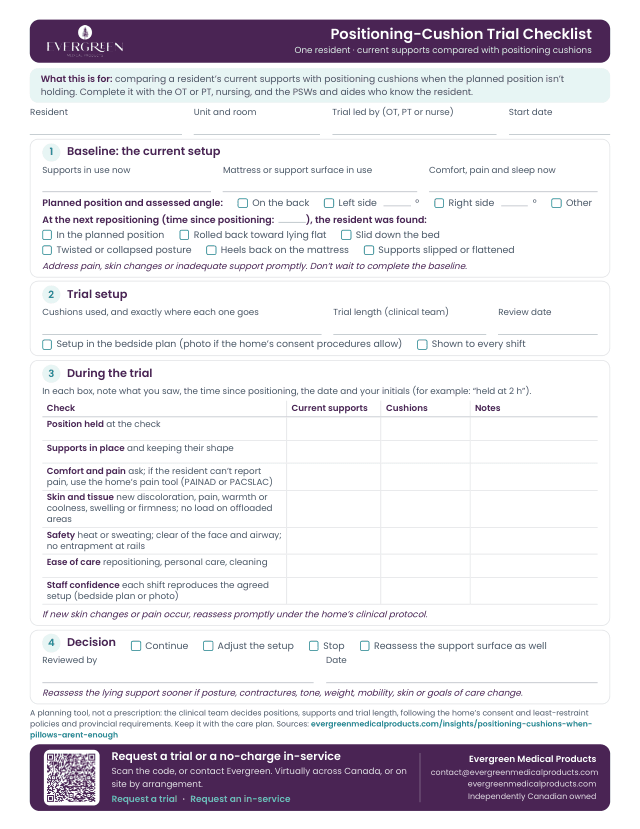
One-page checklist · PDF
Positioning-cushion trial checklist
Four steps: the baseline with the current supports, the trial setup, the seven checks above with current supports and cushions side by side, and the team’s decision. It pairs with the bedside positioning plan (PDF).
Download the checklist (PDF)A setup only holds if every shift can reproduce it. In a 2025 study, 13 occupational therapists across clinical settings in Wales described bed positioning as an individualized intervention that needs the whole team, and asked for more training and support. [10] In a UK care-home project, a short educational video improved care staff’s understanding of contractures. [11] An Evergreen in-service, below, can start the hands-on teaching with your team.
Questions LTC teams ask
Positioning cushions: quick answers
How long does a pillow hold a 30-degree side-lying position?
In one study, 12 aged-care residents were positioned toward a 30° tilt. Over two hours, the average angle went from 27° to 17° with standard pillows, and from 31° to 27° with the tested positioner. The study measured body angle, and the positioner was not an NG cushion. [2]
Are positioning cushions better than pillows?
To help hold the 30-degree side-lying position, the International Guideline advises using positioning devices. In a study it cites, 12 aged-care residents were positioned toward a 30-degree tilt, and a purpose-designed positioning device kept them closer to the target than standard pillows: about 27° versus 17° after two hours. The tested device was not an Evergreen product. Which support suits a resident depends on their assessment. [1][2]
What makes a positioning cushion different from a pillow?
Where are positioning cushions placed?
Where the assessment shows the body needs support to hold the planned position: for example, along the back in side-lying, between the knees and ankles, or under the calves to keep the heels clear. In side-lying, the guideline asks teams to offload other prominences, such as those “between the knees, heels and ankles,” using appropriate repositioning devices. The clinical team chooses each support and where it goes. [1]
Which residents should we trial positioning cushions with?
Residents found off their planned position at the next repositioning, residents of greater weight, and residents with fixed or asymmetric postures or contractures. The clinical team decides, from the resident’s assessment.
How do we run a positioning-cushion trial?
Record a baseline with the current supports, set up the cushions with the OT or PT, then check position, supports, comfort and pain, skin and tissue, safety, ease of care and staff confidence. The clinical team sets the trial length. The one-page trial checklist covers each step.
Do positioning cushions replace repositioning?
No. Supports hold the planned position between repositionings, and the resident’s repositioning plan continues.
Section 7 · From Evergreen
Positioning cushions from Evergreen.
- Equipment information · not study evidence
NG Positioning Cushions are shaped by hand. EverPod fill moves within the cushion so clinicians can contour support around the body. Under load, the pods nest together to provide stable, shapeable support. Combine shapes to support side-lying, lying on the back and sitting.
NG Positioning Cushions in use: two short manufacturer demonstration films
- 0:57
Seahorse Cushion: side-lying positioning demonstration
Watch how the Seahorse Cushion is shaped to support the trunk in side-lying. The clinical team selects the position for the individual resident.
- 0:48
Wave Cushion: lower-limb positioning demonstration
The Wave Cushion is shaped to help keep the hips in a neutral position, with leg channels that keep the knees and ankles apart.
Manufacturer demonstration footage.
Positioning cushions
Trial positioning cushions with the residents whose position doesn’t hold.
Request a positioning-cushion trial for the residents you are assessing, or a no-charge in-service for your team: 45–60 minutes, virtual across Canada or on site by arrangement. Requests come straight to Evergreen, and we reply within 1–3 business days.
Or download the trial checklist (PDF).
About Evergreen. An Evergreen educational summary of published studies and guidelines. The sources do not endorse Evergreen or its products, and none of the studies described tested Evergreen products. Positioning supports work alongside the support surface and individualized repositioning. Selection and use should be based on individual clinical assessment and the product instructions for use.
Explore Evergreen’s positioning cushions.
These links describe Evergreen’s range. They are not study endorsements or product-specific evidence.
Seahorse
Shapeable trunk support for individually assessed lying positions.
View product →
Wave
Supports neutral hip and pelvic positioning while protecting knees, ankles, and heels.
View product →
Sandbar
Wedge-shaped support for limb offloading, joint positioning, and heel protection.
View product →
Reef
Multi-use pelvic, shoulder, and lumbar support; bed-rail protection and post-operative positioning.
View product →
References
- National Pressure Injury Advisory Panel, European Pressure Ulcer Advisory Panel, Pan Pacific Pressure Injury Alliance. Repositioning and Mobilization. In: The International Guideline. 4th ed. 2026. PDF version dated 14 May 2026, pp. 2, 6, 11, 12; the quoted text is unchanged in the online chapter published 24 August 2026. https://www.internationalguideline.com/repositioning
- Kapp S, Gerdtz M, Gefen A, Prematunga R, Santamaria N. An observational study of the maintenance of the 30° side-lying lateral tilt position among aged care residents at risk of developing pressure injuries when using the standard care pillow and a purpose-designed positioning device. Int Wound J. 2019;16(5):1080–1086. doi:10.1111/iwj.13142. Full text: https://pmc.ncbi.nlm.nih.gov/articles/PMC7949259/
- van Helden TMN, Versnel SL, Arkes L, Lindhout M, Mureau MAM, van Neck JW. Quantifying and visualizing the pressure distribution of in-bed positions to reduce pressure injury risk. Adv Skin Wound Care. 2026;39(2):73–79. doi:10.1097/ASW.0000000000000402.
- Osborne LJ, Gowran RJ, Casey J. Evidence for 24-hour posture management: a scoping review. Br J Occup Ther. 2023;86(3):176–187. doi:10.1177/03080226221148414. p. 177.
- National Pressure Injury Advisory Panel, European Pressure Ulcer Advisory Panel, Pan Pacific Pressure Injury Alliance. Preventing Heel Pressure Injuries. In: The International Guideline. 4th ed. Chapter version dated 11 September 2025. H3; p. 4. https://www.internationalguideline.com/heels
- Toole PJ, Kittelson T, Hoffman LA, Hutson J, Bopes K. RESNA position on assistive technology for lying posture care management. Rehabilitation Engineering and Assistive Technology Society of North America; approved February 26, 2025. Published in: Assistive Technology. 38(1):51–60. doi:10.1080/10400435.2025.2543691.
- Norton L, Parslow N, Ho C, O’Sullivan-Drombolis D, Rogers A, Parsons A, Moss L. Best practice recommendations for the prevention and management of pressure injuries. In: Best Practice Recommendations for Skin Health and Wound Management 2025. Toronto: Wounds Canada; 2025. Chapter 7, p. 25. doi:10.56885/GRYI5585. https://www.woundscanada.ca/health-care-professional/publications/bpr-new
- Heyneman A, Vanderwee K, Grypdonck M, Defloor T. Effectiveness of two cushions in the prevention of heel pressure ulcers. Worldviews Evid Based Nurs. 2009;6(2):114–120. doi:10.1111/j.1741-6787.2009.00153.x. PMID: 19422672. Abstract: https://pubmed.ncbi.nlm.nih.gov/19422672/
- Neef HE, Müller-Werdan U, Strube-Lahmann S, Lahmann NA. Contractures: prevalence and associated factors in hospitals and nursing homes — results from two consecutive multicenter cross-sectional studies. Nurs Res Pract. 2026;2026:8458386. doi:10.1155/nrp/8458386.
- Cope R, Reagon C. A qualitative study into the experiences of occupational therapists in addressing bed positioning needs across a range of clinical settings in an area of Wales. Br J Occup Ther. 2025;88(7):408–419. doi:10.1177/03080226241306590.
- Tariq H, Dunn J, Forrester S, Collins K, Porter S. Development and evaluation of a quality improvement educational video on joint contractures for care home staff. BMJ Open Qual. 2024;13(4). doi:10.1136/bmjoq-2024-002923.
Continue the clinical pathway
This article is an educational resource for healthcare professionals and reflects Evergreen’s interpretation of the cited studies and guidelines; read the original sources for full methods and results. It is not intended to replace clinical judgment, individualized resident assessment, facility policy, or product instructions for use.