Last reviewed: November 10, 2026
In this article
A resident can be on the right mattress, with a repositioning plan that is being followed, and still develop a pressure injury on the heel. The International Guideline’s heel chapter explains why: “In adults the posterior aspect of the heel rim is particularly vulnerable, even when a support surface with pressure redistribution properties is used.” [1]
The mattress and the repositioning plan stay in place. The chapter calls them “critically important” for anyone at risk of a heel pressure injury, and describes heel offloading as an additional step in the plan. [1] This article covers that step: who needs it, what floating the heels means, what the trials found, and how to check it at the bedside.
A 30-second read
Clinical takeaways
H1 / H2 / H3: Guideline statements
Do heels need their own plan on a pressure-redistributing mattress?
Yes. Good practice is to elevate the heels of people at risk so they are not in contact with the support surface (H1). [1] BC’s provincial guide puts it in one line: “Always offload heels regardless of the support surface.” [2]
What does floating mean?
The heel is fully free of the mattress, with the weight of the leg spread along the full length of the calf and no direct pressure on the Achilles tendon. [1]
For Directors of Care: does each unit know its first and second choice for heel offloading, and where to find them?
Section 1 · Why heels
Why do heels break down on a good mattress?
- International Guideline · Heels chapter · 2025
- Wounds Canada · Best practice recommendations 2025
The back of the heel has little padding. The chapter notes that it “is covered with only a small volume of subcutaneous tissue,” and that when a person lies supine “the foot is moved into plantarflexion, and the heel rim comes in contact with the supporting surface.” [1] In immobile and critically ill people, it adds, “the heel commonly endures extended pressure from resting on the full body support surface or pillow if it does not receive appropriate preventive care and positioning.” [1]
Wounds Canada’s 2025 best practice recommendations make the same point from the surface side: “The management of heels needs to be considered independently of the pressure redistribution surface.” [3] The surface still does its work for the rest of the body. The heels get a plan of their own, alongside it.
BC provincial quick reference · 2020
Who needs their heels offloaded?
Anyone at risk of, or with, a heel pressure injury
BC’s guide asks teams to consider the person who has: [2]
- A Braden Activity or Mobility subscale score of 3 or less
- Lower-leg concerns: decreased circulation, decreased or absent sensation, or edema
- A wound below the knee
- Recent hip or leg surgery, or a cast or splint
- Contractures or spasticity of the legs or feet
Factors that add to the risk
The International Guideline notes that the risk can be higher with atrophy of the heel’s fat pad in older, frail adults, with altered vascular function such as peripheral vascular disease or diabetes, and with altered sensation such as peripheral neuropathy or spinal cord injury. [1]
BC’s guide advises consulting OT or PT and a wound clinician when the Braden Activity or Mobility subscale score is 2 or less, or when a wound is present on a heel. [2]
Section 2 · The position
What does floating the heels mean?
- H1 · Good practice statement
- Heels chapter · Implementation considerations
“It is good practice to elevate the heels of individuals at risk of pressure injuries, so the heels are not in contact with the support surface.”
International Guideline, 4th ed. · Heels chapter · H1, good practice statement · 2025 [1]
The chapter describes the target plainly: heels “should be elevated in such a way that they are fully free from the full body support surface (a state sometimes called ‘floating heels’).” [1] How the leg is supported matters as much as the gap under the heel.
Heels chapter · Implementation considerations
Support the calf; float the heel
Calf
Spread the weight of the leg “along the full length of the calves ensuring that no direct pressure is applied to the Achilles tendon, popliteal vein or peroneal nerve.” [1]
Knee
“Position the knee in slight (5° to 10°) flexion.” [1] Wounds Canada gives the reason: “Knees should be slightly flexed to prevent popliteal vein obstruction and avoid pressure over the Achilles tendon.” [3]
Foot
The foot is “positioned in neutral to slight dorsiflexion (slightly upwards).” [1]
The chapter’s reasoning is mechanical. The heel’s surface area is small, so redistributing load there “can be challenging, and fully offloading pressure by elevation is good clinical practice.” It cites an observational study in which tissue blood flow to the heels increased when they were fully offloaded. [1]
Section 3 · The evidence
What did the trials find?
- H2 · Conditional recommendation, low certainty
- Heyneman 2009 · Wedge cushion vs pillow, over-75s
- Donnelly 2011 · Randomized trial, hospital
The heel chapter cites several randomized trials that “showed a reduction in heel PI occurrence when heel elevation is implemented.” [1] Wounds Canada’s 2025 best practice recommendations go a step further and compare two ways of supporting the lower legs. [3]
“Evidence suggests that the use of a wedge-shaped cushion to suspend the heels off the bed is more effective in reducing the incidence of pressure ulcers than the use of a standard pillow.”
Wounds Canada · Best Practice Recommendations 2025 · Pressure injuries chapter [3]
That statement cites a trial in people over 75, the first of the two below. [3][4] The second, in hospital, asked the question a long-term-care team asks: does heel elevation add anything for someone who is already on a pressure-redistributing surface? [5]
Heyneman et al., 2009 · Comparative trial · Patients over 75
1.9% vs 10.2%
Heel pressure ulcers, grades 2–4 · wedge-shaped cushion vs an ordinary pillow under the lower legs
Wedge-shaped cushion 1.9%; Ordinary pillow 10.2%.
- Patients
- 162 patients over 75 years of age. All were lying on a viscoelastic foam mattress and were repositioned every 4 hours.
- Design
- A comparative study, indexed by PubMed as a randomized controlled trial: a wedge-shaped, bed-wide viscoelastic foam cushion under the lower legs against an ordinary pillow.
- Finding
- “The incidence of heel pressure ulcers grades 2-4 was 1.9% in the wedge-shaped cushion group and was 10.2% in the pillow group” (p = 0.03).
- Authors’ conclusion
- “The study provides evidence that a wedge-shaped, bedwide, viscoelastic foam cushion decreases the risk of developing a heel pressure ulcer compared with the use of a pillow.”
- Limits
- One trial, read here from its abstract, which does not name the care setting. The cushion was a bed-wide wedge, not an Evergreen product.
Heyneman et al., 2009 · Worldviews on Evidence-Based Nursing [4]
Donnelly et al., 2011 · Randomized trial · Hospital hip-fracture patients
0 of 120 vs 29 of 119
Patients with a new pressure ulcer on the ankles, feet or heels · heel elevation device plus the surface vs the surface alone
Heel elevation device plus pressure-redistributing surface: 0 of 120; Pressure-redistributing surface alone: 29 of 119. Highlighted: Developed a new pressure ulcer on the ankles, feet or heels.
- Patients
- 239 patients aged over 65 with a fractured hip, in a hospital fracture trauma unit. People with existing heel damage were excluded.
- Design
- Randomized trial. Every patient had a pressure-redistributing support surface; the intervention group also had a heel elevation device.
- Finding
- “No subjects in the intervention group developed a PU on their ankles, feet or heels, whereas 29 subjects in the control group did (p<0.001).” Across all body sites, 8 of 120 (7%) developed a pressure ulcer with heel elevation, compared with 31 of 119 (26%) on the surface alone.
- Limits
- Hospital patients after hip fracture, not long-term-care residents. The trial studied one commercial heel elevation device.
Donnelly et al., 2011 · Journal of Wound Care [5]
The guideline’s own analysis looked at a different kind of device. Pooling two critical-care trials of a heel offloading boot, it found heel pressure injuries on 0.4% of heels, compared with 8.4% with standard pillows or a regular foam bootee, and it has “very little confidence that this effect estimate represents a true effect.” Its conclusion is that when the device suits the person’s mobility and activity level, “the balance of effects probably favors using a heel offloading device,” and it suggests using one (H2). [1]
Section 4 · The method
Pillows or a device?
- H2 · Conditional recommendation, low certainty
- H3 · Good practice statement
| Method | Where it fits | What to watch |
|---|---|---|
| Pillows | BC’s guide starts here: “Use as many pillows as needed to elevate the heels off the mattress.” [2] The guideline makes pillows or cushions good practice when a device is not available or does not suit the person’s activity and mobility (H3). [1] | One pillow lengthwise under each calf, starting just below the hollow behind the knee, high enough to keep the heels clear after the legs settle. Check and readjust regularly. [1][2] |
| Purpose-made heel offloading device (cushion, wedge or boot) | Suggested when it suits the person’s mobility and activity level (H2). [1] BC’s guide moves to the unit’s offloading wedge or boot when pillows are not effective. [2] Wounds Canada points to evidence that a wedge-shaped cushion is more effective than a standard pillow. [3] A device may suit people who move their legs often and dislodge pillows. [1] | Any device: follow the product’s instructions, including how to fit it to the person; a device that is not correctly fitted and used could itself cause a pressure injury. Don’t put a sheet or pillowcase over it, which can hammock and make the device less effective; use a correctly fitted cover. [1][2] A boot: consider shoe size when fitting it, don’t add a pillow under the knee, which can bring the heel back onto the mattress, and remove it at the start of each shift to check the foot and leg. [1][2] |
| Not for offloading | Rolled blankets or towels, IV fluid bags, and sheepskin used as the only strategy. [1][2] | Rolled items press on the back of the foot. A fluid bag is off-label and “not recommended.” Sheepskin “will reduce friction but not pressure.” [1][2] |
Selection considers activity, mobility and falls risk, heel risk factors, clinical condition including cognition, skin integrity and edema, alignment of the hip, foot and lower leg, and the person’s preferences and tolerance. [1]
As mobility changes
Reassess the method when the resident’s activity changes, and “change to a different heel offloading option (e.g. pillows or cushions) when appropriate.” The guideline asks two questions: is the device restricting bed mobility as the person recovers, and is a fitted device, such as a boot, increasing the risk of falls when they walk? [1]
Section 5 · The check
How do we check that the heel is floating?
- Heels chapter · Implementation considerations
- BC provincial quick reference · 2020
At the bedside
Five checks for every heel offloading plan
1. Let the leg settle
BC’s guide: “Allow the weight of the leg to ‘settle’ into the offloading device (pillow, wedge, boot). Then slide your hand under the heel, if it slides easily under the heel, the heel is offloaded.” [2]
2. Check again
The guide asks for a check at least every 2 hours that the heels are still offloaded, with ankle range-of-motion exercises at each check. [2] Pillows move, and the guideline adds: “Regularly check and readjust pillows to ensure the heel remains offloaded.” [1]
3. Look at the skin
“Assess the heels regularly,” leaving them exposed where possible. [1] Look for redness that does not fade when pressed, a blister or a wound. [2] Remove the heel offloading device at least twice a day to check the skin, circulation and swelling, and more often with edema or for residents at higher risk, such as those with poor circulation, diabetes, reduced sensation or difficulty reporting pain. [1] With a boot, BC’s guide has staff remove it at the start of each shift and check the foot and leg. [2]
4. Mind the heels when moving
“Pay particular attention to the individual’s heels during transfers.” [6] When repositioning, BC’s guide says to lift the heels to avoid friction and shear. [2] In side-lying, offload between the knees and ankles as well. [2][6]
5. Ask about comfort
“Evaluate the individual’s comfort at regular intervals. Some heel offloading devices may be too warm or uncomfortable.” [1]
Where the bed has the feature, the guideline notes that the foot of the bed can be lowered to offload pressure from the heel. [1]
Hypothetical teaching scenario · for discussion
Example: a red heel on a good mattress
A long-term-care resident with advanced dementia spends most of the day in bed on a pressure-redistributing mattress, and her repositioning plan is being followed. Her heels have been floated on pillows since admission, when her risk was identified, but she moves her legs often and by morning the pillows are beside her. A care aide notices redness on the back of one heel. It fades when pressed.
The team keeps the mattress and the repositioning plan. Because the pillows are not staying in place, it moves to the unit’s next choice, a heel offloading device suited to someone who moves her legs often, and asks the OT to confirm the choice and the fit. [1][2] Staff slide a hand under each heel once the legs have settled, check at least every 2 hours that the heels are still clear, and look at the skin. Redness that no longer fades when pressed would be a sign of pressure injury [2] and a reason to bring in the wound clinician.
Takeaway. The heel plan sits alongside the surface plan. One does not replace the other.
Section 6 · From Evergreen
Putting heel floating into practice with Elevate.
- Equipment information · not study evidence
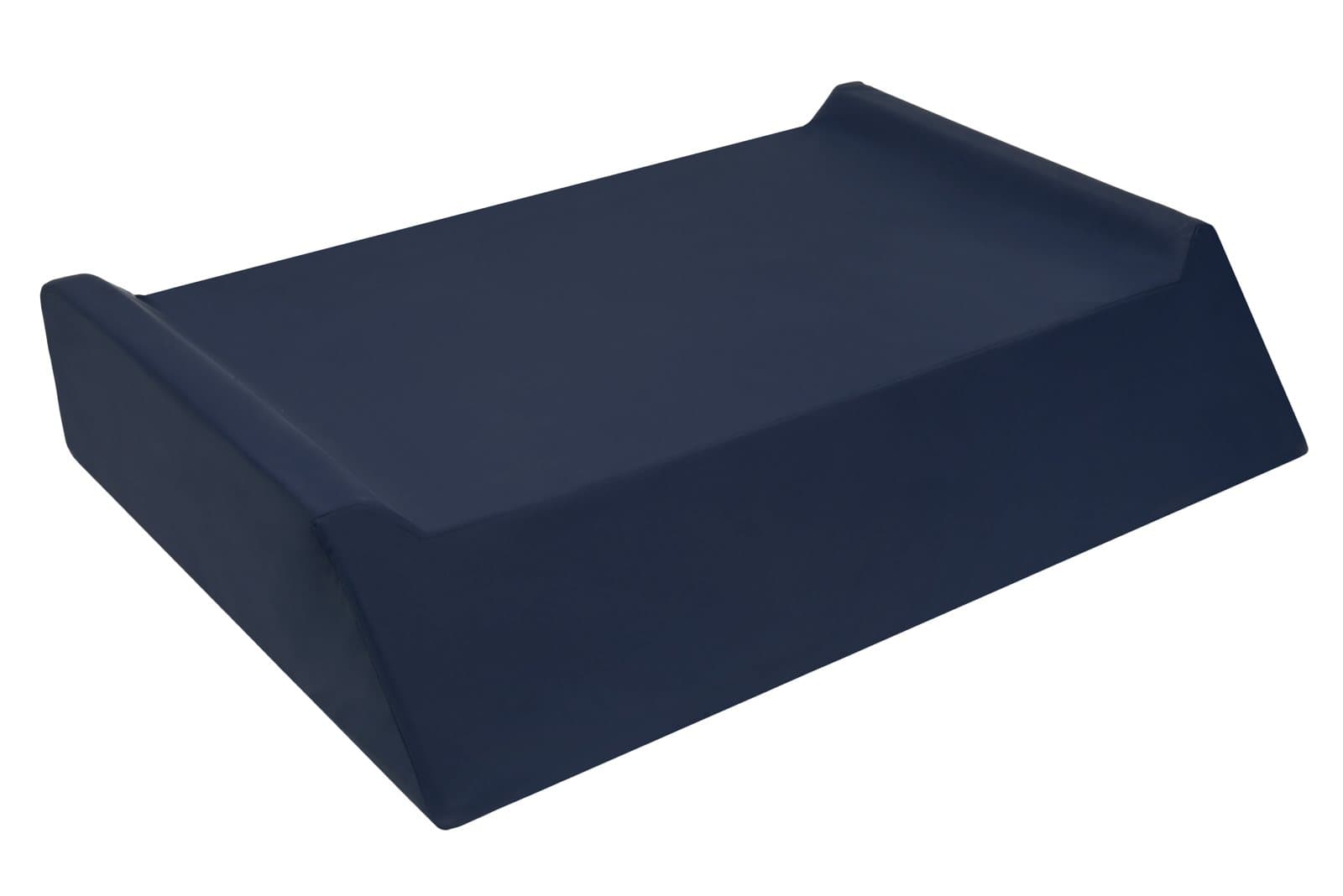
Elevate is Evergreen’s heel offloading cushion, designed for heel and ankle offloading when a resident is lying supine. It cradles the leg while elevating the heel from the mattress, and its raised side bolsters help keep the lower leg aligned. The steps below are Evergreen’s placement notes for Elevate. They sit alongside the bedside checks in Section 5 and don’t replace them.
Elevate · Placement and daily check
Place it, float the heels, then check
1. Place
With the resident lying supine, gently lift the lower legs and place Elevate directly under them, leaving clearance below the knees. It sits widthwise and upright, with the side bolsters parallel to the mattress edges.
2. Float
The heels should be suspended and free of any contact with the mattress. Let the legs settle, then use the hand check from Section 5 on each heel.
3. Check each day
Confirm the heels are still clear of the mattress, and look for redness or irritation where the legs rest on the cushion: the back of the lower legs and behind the knees.
4. Keep the cover clear
Use Elevate in its own cover. Extra sheets or incontinence pads on top are not recommended, because they can create wrinkles and creases that lead to pressure points.
Elevate is not recommended for residents with knee contractures that prevent proper positioning, open ulcers on the back of the lower legs, or severe arterial insufficiency. Its use should be based on assessment by a healthcare professional.
Explore Elevate for its specifications, cleaning steps and full placement notes, or request a heel offloading in-service for your team.
Questions teams ask
Education for your team
Bring heel offloading to your next in-service.
Request an in-service on heel offloading and 24-hour positioning: where heels are at risk, how to float them, and the bedside check. Bring your team’s questions and anonymized resident examples.
Or ask about a dealer-coordinated demonstration.
About Evergreen. An Evergreen educational summary of published studies and guidelines. Practical examples illustrate application. The sources do not endorse Evergreen or its products, and the trials described studied other devices. Heel offloading does not replace the support surface or repositioning. Selection and use should be based on individual clinical assessment and the product instructions for use.
Explore Evergreen’s products for heel care.
These links describe Evergreen’s range. They are not study endorsements or product-specific evidence. On a surface with HeelOffload the heel still rests on the mattress, so heels at risk are floated as well.
References
- National Pressure Injury Advisory Panel, European Pressure Ulcer Advisory Panel, Pan Pacific Pressure Injury Alliance. Preventing Heel Pressure Injuries. In: Haesler E, ed. Prevention and Treatment of Pressure Ulcers/Injuries: Clinical Practice Guideline. The International Guideline. 4th ed. 2025. Version date 11 September 2025. H1, H2, H3; pp. 1–6. https://www.internationalguideline.com/heels
- BC Provincial Interprofessional Skin & Wound Committee. Heel Offloading: Quick Reference Guide. May 2020. p. 1. https://www.clwk.ca/get-resource/heel-offloading-qrg/
- Norton L, Parslow N, Ho C, O’Sullivan-Drombolis D, Rogers A, Parsons A, Moss L. Best practice recommendations for the prevention and management of pressure injuries. In: Best Practice Recommendations for Skin Health and Wound Management 2025. Toronto: Wounds Canada; 2025. Chapter 7, pp. 25, 27. doi:10.56885/GRYI5585. https://www.woundscanada.ca/health-care-professional/publications/bpr-new
- Heyneman A, Vanderwee K, Grypdonck M, Defloor T. Effectiveness of two cushions in the prevention of heel pressure ulcers. Worldviews Evid Based Nurs. 2009;6(2):114–120. doi:10.1111/j.1741-6787.2009.00153.x. PMID: 19422672. Abstract: https://pubmed.ncbi.nlm.nih.gov/19422672/
- Donnelly J, Winder J, Kernohan WG, Stevenson M. An RCT to determine the effect of a heel elevation device in pressure ulcer prevention post-hip fracture. J Wound Care. 2011;20(7):309–312, 314–318. doi:10.12968/jowc.2011.20.7.309. PMID: 21841719. Abstract: https://pubmed.ncbi.nlm.nih.gov/21841719/
- National Pressure Injury Advisory Panel, European Pressure Ulcer Advisory Panel, Pan Pacific Pressure Injury Alliance. Repositioning and Mobilization. In: The International Guideline. 4th ed. 2026. Version date 14 May 2026. pp. 4, 12. https://www.internationalguideline.com/repositioning
Continue the clinical pathway
This article is an educational resource for healthcare professionals and reflects Evergreen’s interpretation of the cited studies and guidelines; read the original sources for full methods and results. It is not intended to replace clinical judgment, individualized resident assessment, facility policy, or product instructions for use.