Last reviewed: November 13, 2026
In this article
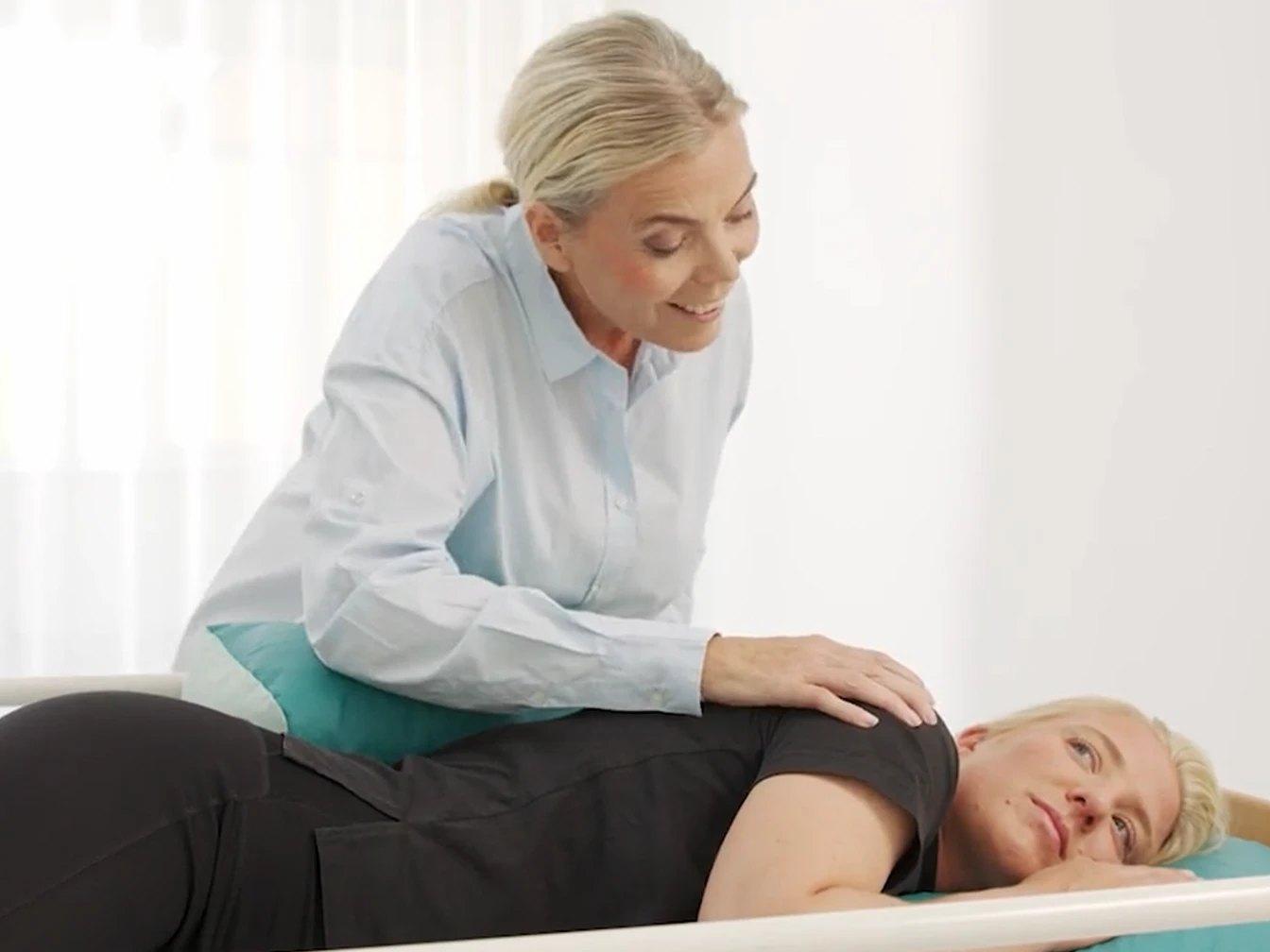
Positioning doesn’t stop at the wheelchair. For a resident who cannot change or hold a comfortable position on their own, how they are supported in bed matters as much as how they are supported in the chair, around the clock. That is 24-hour positioning.
RESNA defines 24-hour posture care as “a collaborative therapeutic process by which a person who has limited mobility is enabled to lie, sit, and stand in increased symmetry through skillful placement of therapeutic supports.” Its 2025 position paper says lying posture care “should be implemented as standard practice.” [1] The 2026 International Guideline asks every care team to “consider an individual’s positioning needs over a 24-hour period when developing a repositioning regimen. This should include where and when they sleep, lie and sit.” [2]
This guide shows how to start: a few residents on one unit, a plan every shift can follow, and a review that shows what to build next. For the wider case across settings, see 24-Hour Positioning: When Seating Isn’t Enough.
Up to 12 hours a day
In the same posture when lying unsupported · people with limited mobility
People with mobility impairments often have difficulty changing position or holding a stable midline position when lying on their backs. Lying unsupported, they “may spend up to 12 hours per day in the same destructive postures, which equates to 4,368 hours per year.”
RESNA, 2025 [1]
A 30-second read
Clinical takeaways
RESNA 2025 · International Guideline 2026
24-hour positioning is standard practice.
RESNA describes lying posture care as the foundational element of 24-hour posture care and recommends it as standard practice. The International Guideline asks teams to plan positioning across the full 24 hours, including the hours in bed. [1][2]
Build the plan around the resident.
Assess movement, alignment, comfort, skin and daily routines. Plan supported positions, including 30° side-lying rather than 90°, with supports that hold them. [2]
Make it work on every shift.
Give each shift a clear bedside plan, hands-on teaching and a named person to ask. Review comfort, skin and positioning from the first use, and whenever needs change.
For Directors of Care: which three to five residents on one unit would you start with, and who will champion the plan on each shift?
Section 1 · Recognize the need
Who needs 24-hour positioning in long-term care?
- RESNA position paper · 2025
- Hill & Goldsmith · 2010
Start with the resident’s ability to move and to hold a supported position. RESNA names people after a stroke, and people with multiple sclerosis, ALS, intellectual disability or advanced dementia, among those who “would be candidates” for lying posture care. It adds that “people requiring support for sitting and standing usually require support for lying.” [1]
Hill and Goldsmith explain why the hours in bed matter: “any individual developing a destructive habitual lying posture can be considered at risk of developing distortions of body shape which will compromise respiration, circulation and digestion.” [3]
Long-term care sees this often. In two multicentre studies in Germany of 2,012 people aged 65 and over, 19.3% of nursing-home residents had at least one contracture, compared with 7.7% of hospital patients. Across both settings, people who were bedridden had about four times the odds of a contracture. [4]
| What the team notices | What to explore |
|---|---|
| The resident cannot reposition independently | How supported positions and assisted position changes will work across the day and night |
| The head, trunk or limbs repeatedly settle into an unsupported posture | Whole-body alignment, available movement, and where support is needed |
| The resident reports or shows discomfort in bed or during care | Position, pain, tolerance and the resident’s preferences |
| The resident needs substantial seating support | Whether the same postural needs have been assessed in bed |
| Skin, mobility or care needs have changed | Whether the positioning plan and the support surface still meet current needs |
Use these prompts to choose the first residents to assess.
There are clear health and wellbeing benefits from the provision of 24-hour posture management for people who are unable to change their position independently.
Osborne, Gowran & Casey · Evidence for 24-hour posture management: a scoping review · British Journal of Occupational Therapy, 2023 [5]
Start small. Choose three to five residents on one unit, and name a positioning champion on each shift. A small start that works is easier to extend than a large one that slips.
Section 2 · Assess the whole day
Assess the whole day, not only the bed.
- International Guideline · Repositioning chapter · 2026
- Osborne et al. · scoping review · 2023
Bring together the resident, their family or substitute decision-maker, the OT or PT, the RN, RPN or LPN, and the health care aides and PSWs who see the resident on each shift. The guideline asks teams to “work with the individual, their informal carer and the collaborative healthcare team” and to consider “the individual’s goals of care and priorities.” It also asks them to “assess the individual’s full body when repositioning” and to “evaluate body alignment and posture to maximize comfort, support and pressure offloading.” [2]
Assess lying and sitting together. A 2023 scoping review explains why: “If posture is not examined collectively in each orientation of sitting, lying and standing, it can be counter-productive to the provision of postural supports in only one orientation.” It adds that “positioning during the day can be influenced by the position adopted overnight.” [5]
What the assessment covers
The body
- How the resident lies when left alone
- Joint movement, and the alignment of the head, trunk, pelvis and limbs
- Pain on movement
- Skin condition and pressure points; heels get their own plan (see Floating the Heels)
- Breathing, swallowing and temperature
The day and the person
- Hours in bed and in the chair, and the sleep pattern
- Transfers, care tasks, and the bed and surface in use
- What the resident finds comfortable, and their goals
- Priorities: the guideline asks teams to “evaluate the individual’s priorities (e.g., un-interrupted sleep versus more frequent PI preventive care) and discuss benefits, risks and strategies to meet the individual’s needs.” [2]
Agree on a starting goal, such as more comfortable supported lying or a setup every shift can reproduce. Record a simple baseline: comfort, sleep, pain, skin, and a photo of the usual lying posture, following the home’s consent and privacy procedures.
Section 3 · Make the plan
Make a bedside positioning plan every shift can follow.
- International Guideline · R10 · 30° lateral positioning
- RNAO · Positioning in long-term care · 2007
Turn the assessment into a short, resident-specific bedside plan, agreed with the resident or substitute decision-maker and recorded in the plan of care. RNAO’s positioning education for long-term care sets out the principle: “The resident’s body should be supported with positioning aids to maintain good alignment.” It adds that “the amount of support required for positioning depends on the individual resident.” [6]
International Guideline · R10 and implementation notes
Side-lying at 30°, not 90°
Why 30°
The guideline recommends 30° lateral positioning for people at risk of pressure injuries (R10). It is associated with lower interface pressure and higher transcutaneous oxygen than 90° side-lying. [2]
Individualize the angle
Turning angles are individualized “to ensure maximum offloading of both the sacrum and the trochanter.” At a higher body mass index, a 40° position may be needed. [2]
Avoid 90°
“Avoid lying positions that increase pressure, such as the 90-degree lateral position.” [2]
Support the legs
Positioning the upper leg forward of the lower leg, supported by a pillow, may increase comfort and stability. Other prominences, such as between the knees, the heels and the ankles, are offloaded with appropriate devices. [2]
18.5 vs 24.5 min
Mean daily nursing time for repositioning · three-hourly 30° regimen vs six-hourly 90° repositioning
In this Irish LTC trial (12 long-term care hospitals for older people, 213 residents, four weeks), mean daily nursing time for repositioning was 18.5 minutes with the three-hourly 30° regimen, versus 24.5 minutes with six-hourly 90° repositioning. The International Guideline notes that the study “demonstrated that 30-degree lateral positioning was cost effective based on the associated lower rate of PIs and lower nursing time costs.” Repositioning frequency is set for each resident by the care team, within the home’s policy.
Three-hourly, 30° tilt 18.5 min a day; Six-hourly, 90° lateral 24.5 min a day.
Moore et al., J Clin Nurs 2011 [7] and 2013 [8]; International Guideline 2026 [2]
| Record this | Make it clear enough for the next shift |
|---|---|
| Resident’s goal and preferences | What matters to this resident, and which positions are tolerated |
| Planned positions | For example, supported on the back and 30° side-lying, and where the head, trunk, pelvis, arms and legs need support |
| Equipment and placement | Which supports to use and exactly where they go, with an agreed photo or diagram. No pillow directly against the sacrum in side-lying, no objects, such as a phone or cutlery, left under the resident, and no positioning on bony prominences with non-blanchable redness [2] |
| Movement and repositioning | What the resident can do, what staff assist with, and the individual schedule |
| Checks and escalation | Comfort, skin, breathing and swallowing, heat, entrapment, support placement, and whom to contact |
| Review | The named clinician or team, the planned review, and triggers for earlier reassessment |
RESNA asks teams to “monitor the individual for postural asymmetry, entrapment, thermal dysregulation, aspiration, and pressure injuries.” For residents at risk of aspiration, it notes that “head and upper body elevation” may be used as appropriate. [1] The NSW Agency for Clinical Innovation’s sample bed-positioning plan is a useful model. [9] Download the one-page bedside positioning plan (PDF)
Roles
Who does what on the unit
OT or PT
Assesses the resident, writes the plan and sets the review.
RN, RPN or LPN
Adds the plan to the plan of care and checks the skin.
Health care aides and PSWs
Set up each position from the bedside photo, and report supports that slip or no longer fit.
Shift champion
Checks setups at handover and coaches relief staff.
Director of Care
Chooses the starting unit and protects time for hands-on teaching.
RESNA is clear that posture supports differ from restraints: they are “devices intended for safeguarding posture and providing comfort,” and they “should be removable by the individual when they have the motor skill to do so.” [1] Record the plan and consent in the plan of care, and follow your home’s least-restraint policy and provincial requirements, such as Ontario’s rules on personal assistance services devices.
Positioning supports and the right mattress work together. Repositioning continues on every surface, because “no support surface can entirely replace repositioning.” [2]
Section 4 · Trial the supports
Trial positioning supports around the resident.
- International Guideline · Repositioning chapter · 2026
- Pickenbrock et al. · randomized trial · 2015
Trial supports in the bed and chair where they will be used, and judge them on what good positioning supports do.
International Guideline 2026 · RESNA 2025
What good positioning supports do
Hold the position
Positioning devices “can assist in maintaining positioning, be used to elevate parts of the body off the support surface, and can promote body symmetry, posture and comfort.” The guideline advises using them “to assist the individual to maintain the 30-degree lateral position more effectively.” [2]
Keep their shape
Teams “evaluate the effectiveness of the devices in sustaining the individual’s position (e.g. smaller/less dense pillows and wedges may flatten when used to position individuals of greater weight).” [2]
Stay secure
Positioning elements “need to be securely placed… so that the user remains stable and safe.” “Large, loose pillows are avoided because they are ineffective and potentially unsafe.” [1]
Fit the body
For individual body shapes, the guideline points to “specialist repositioning devices to support the individual’s specific needs/body shape.” [2] With the whole body well supported, the resident can rest in “a stable, relaxed and more symmetrical body position that limits the risk for entrapment.” [1]
Introduce new supported positions during the day, with the clinical team setting the trial duration and checking skin, comfort and safety before extending use. Check that the supports stay in place and still allow care and position changes. Label each resident’s supports and keep them at the bedside, and plan cleaning and storage so the next shift has them when it needs them.
Ask about comfort before and after positioning: the guideline asks teams to “assess the individual’s pain and comfort level before and after repositioning.” [2] Where communication is limited, use the home’s pain tool, such as PAINAD or PACSLAC, and the staff who know the resident best.
Comfort is where well-supported positioning shows quickly. In the trial below, neutral positioning (LiN) meant that “all parts of the body are supported against the influence of gravity” and “every hollow space should be filled.” [10]
81% vs 38%
Rated their comfort as good after two hours · neutral positioning (LiN) vs conventional positioning
Randomized trial of 218 non-ambulatory adults with neurological conditions at 22 centres, including nursing homes; comfort was rated by the 138 able to communicate.
Neutral positioning (LiN): 56 of 69; Conventional positioning: 26 of 69. Highlighted: Rated their comfort as good.
Pickenbrock et al., Dtsch Arztebl Int 2015 [10]
Section 5 · Teach every shift
Teach 24-hour positioning to every shift.
- RESNA position paper · 2025
- RNAO · self-directed learning package · 2007
RESNA’s definition rests on “skillful placement of therapeutic supports.” [1] That skill is learned at the bedside, by every shift that will use the plan.
A training plan for one unit
Teach it
- Demonstrate each resident’s setup, then have each staff member set it up while the trainer watches
- Cover four questions: what position are we supporting; where does each support go, and how do we check the whole body; how do we reposition and give care with this setup; and what changes mean we ask for a review
- Include day, evening and night staff, and give family members who help with care a short orientation
Keep it going
- Name a positioning champion on each shift
- Check the bedside photo and plan at shift handover for the first two weeks
- Make sure relief staff can find the current plan
Book hands-on teaching before the supports arrive, including evening and night staff. RNAO’s free self-directed package, Positioning Techniques in Long-Term Care, is a useful pre-read. [6] An Evergreen in-service can start this teaching with your team: request one.
A North American program used the same ingredients. The Montana Postural Care Project combined positioning supports for lying, a personalized training workshop for each caregiver team, and in-home follow-up assessments to build a personalized care plan. The authors concluded that it “established the feasibility of administering posture care management in North America.” [11]
Section 6 · Review and build
Review the results and build from there.
- Stephens & Bartley · care-home pilot · 2020
Review each resident’s response from the first use: comfort, sleep, pain and skin; whether the resident stays comfortable and at a comfortable temperature; whether the supports stay in place; and whether every shift can reproduce the setup. The guideline notes that priorities can change over time and that “the repositioning regimen should be regularly evaluated.” [2] Reassess promptly when the resident’s condition, weight or tolerance changes.
After the first month, review the program itself. Ask staff, residents and families what made the plan easy or hard to follow, and adjust equipment access, documentation and teaching before extending it to more residents.
Care-home pilot · night-time positioning
“There were notable benefits of [night-time positioning equipment] use in terms of participants’ pain levels, sleep quality, risk of pressure ulcers, risk of choking, and weight.”
Pilot study · 10 UK care-home residents with postural asymmetry · 12 weeks
Residents trialled night-time positioning equipment for 12 weeks, with standardised assessments before and after each trial, interviews with residents and relatives, and staff focus groups. The authors also reported evidence of improvements in function, ability to undertake activities of daily living and quality of life.
Questions LTC teams ask
24-hour positioning: quick answers
Section 7 · From Evergreen
Starting 24-hour positioning with Evergreen.
- Equipment information · not study evidence
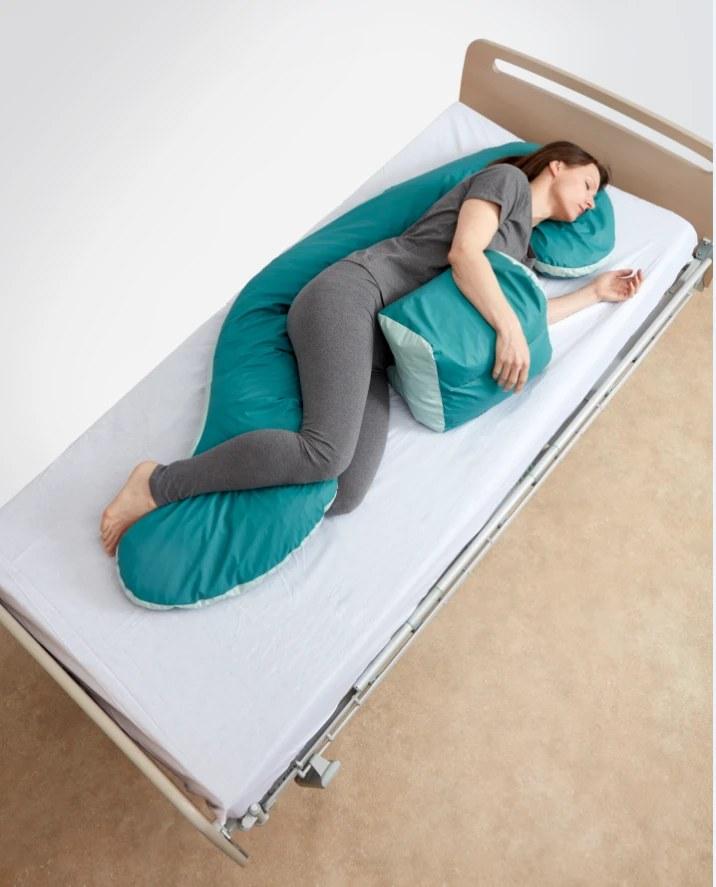
NG Positioning Cushions are soft to the touch, stable under the body’s weight, and shaped by hand. Every NG cushion has the same EverPod fill: small, egg-shaped pods that move within the cushion, so clinicians can contour support around the body, accommodate asymmetry and adjust positioning as needs change. Under the body’s weight, the pods settle and nest together, and the fill stays where you shape it, without feeling rigid. Each pod returns to its shape after it is compressed.
A genuine Dartex cover, waterproof, breathable and four-way stretch, moves with the cushion. Use a cushion on its own, or combine shapes to support the whole body in lying, side-lying and sitting, in adult and pediatric sizes. Watch the cushions in use on the positioning cushions page.
Between residents, clean and disinfect the cushions following the cleaning instructions, and let them dry fully before use. They are wiped, not machine washed, so they stay out of the laundry.
Evergreen in-services are no-charge, 45–60 minute sessions, virtual anywhere in Canada or on site by arrangement. Bring three to five anonymized resident examples, and our clinical educator will work through positions and support placement with your team. Requests come straight to Evergreen, and we reply within 1–3 business days. The one-page bedside positioning plan (PDF) is ready to print for your first residents.
24-hour positioning
Start 24-hour positioning on one unit.
Request a 24-hour positioning in-service: 45–60 minutes, virtual across Canada or on site by arrangement, at no charge. Or ask about a positioning-cushion demonstration or trial for the residents you are assessing. Requests come straight to Evergreen.
About Evergreen. An Evergreen educational summary of published studies and guidelines. Practical examples illustrate application. The sources do not endorse Evergreen or its products, and none of the studies described tested Evergreen products. Positioning supports work alongside the support surface and individualized repositioning. Selection and use should be based on individual clinical assessment and the product instructions for use.
Explore Evergreen’s positioning cushions.
These links describe Evergreen’s range. They are not study endorsements or product-specific evidence.
References
- Toole PJ, Kittelson T, Hoffman LA, Hutson J, Bopes K. RESNA position on assistive technology for lying posture care management. Rehabilitation Engineering and Assistive Technology Society of North America; approved February 26, 2025. Published in: Assistive Technology. 38(1):51–60. doi:10.1080/10400435.2025.2543691.
- National Pressure Injury Advisory Panel, European Pressure Ulcer Advisory Panel, Pan Pacific Pressure Injury Alliance. Repositioning and Mobilization. In: The International Guideline. 4th ed. 2026. Version date 14 May 2026. pp. 1, 2, 6, 11, 12. https://www.internationalguideline.com/repositioning
- Hill S, Goldsmith J. Biomechanics and prevention of body shape distortion. Tizard Learning Disability Review. 2010;15(2):15–29. doi:10.5042/tldr.2010.0166. p. 15.
- Neef HE, Müller-Werdan U, Strube-Lahmann S, Lahmann NA. Contractures: prevalence and associated factors in hospitals and nursing homes — results from two consecutive multicenter cross-sectional studies. Nurs Res Pract. 2026;2026:8458386. doi:10.1155/nrp/8458386.
- Osborne LJ, Gowran RJ, Casey J. Evidence for 24-hour posture management: a scoping review. Br J Occup Ther. 2023;86(3):176–187. doi:10.1177/03080226221148414. pp. 177, 183, 185.
- Registered Nurses’ Association of Ontario. Positioning Techniques in Long-Term Care: Self-directed learning package for health care providers. RNAO; 2007. pp. 7, 12.
- Moore Z, Cowman S, Conroy RM. A randomised controlled clinical trial of repositioning, using the 30° tilt, for the prevention of pressure ulcers. J Clin Nurs. 2011;20(17–18):2633–2644. doi:10.1111/j.1365-2702.2011.03736.x.
- Moore Z, Cowman S, Posnett J. An economic analysis of repositioning for the prevention of pressure ulcers. J Clin Nurs. 2013;22(15–16):2354–2360. doi:10.1111/j.1365-2702.2012.04310.x.
- NSW Agency for Clinical Innovation. Individualised bed positioning and repositioning plan (sample). Spinal Cord Injury Service Pressure Injury Toolkit. October 2017.
- Pickenbrock H, Ludwig VU, Zapf A, Dressler D. Conventional versus neutral positioning in central neurological disease: a multicenter randomized controlled trial. Dtsch Arztebl Int. 2015;112(3):35–42. doi:10.3238/arztebl.2015.0035.
- Kittelson T, Kittelson-Aldred A, Justad JM, Hoffman LA, Coombs NC. The Montana Postural Care Project: a pilot study implementing posture care management in a rural, low-resource region. Heliyon. 2024;10(11):e31752. doi:10.1016/j.heliyon.2024.e31752.
- Stephens M, Bartley C. Use of night-time positioning equipment in care home residents with postural asymmetry: a pilot study. Nurs Older People. 2020;32(3):17–24. doi:10.7748/nop.2020.e1216.
Continue the clinical pathway
This article is an educational resource for healthcare professionals and reflects Evergreen’s interpretation of the cited studies and guidelines; read the original sources for full methods and results. It is not intended to replace clinical judgment, individualized resident assessment, facility policy, or product instructions for use.