Last reviewed: November 19, 2026
In this article
An equipment list might call a mattress foam, air, reactive, alternating pressure or low air loss. Many people simply say pressure relief mattress or air mattress. These labels answer different questions, and knowing them helps a team see what the current mattress does and what it leaves to staff.
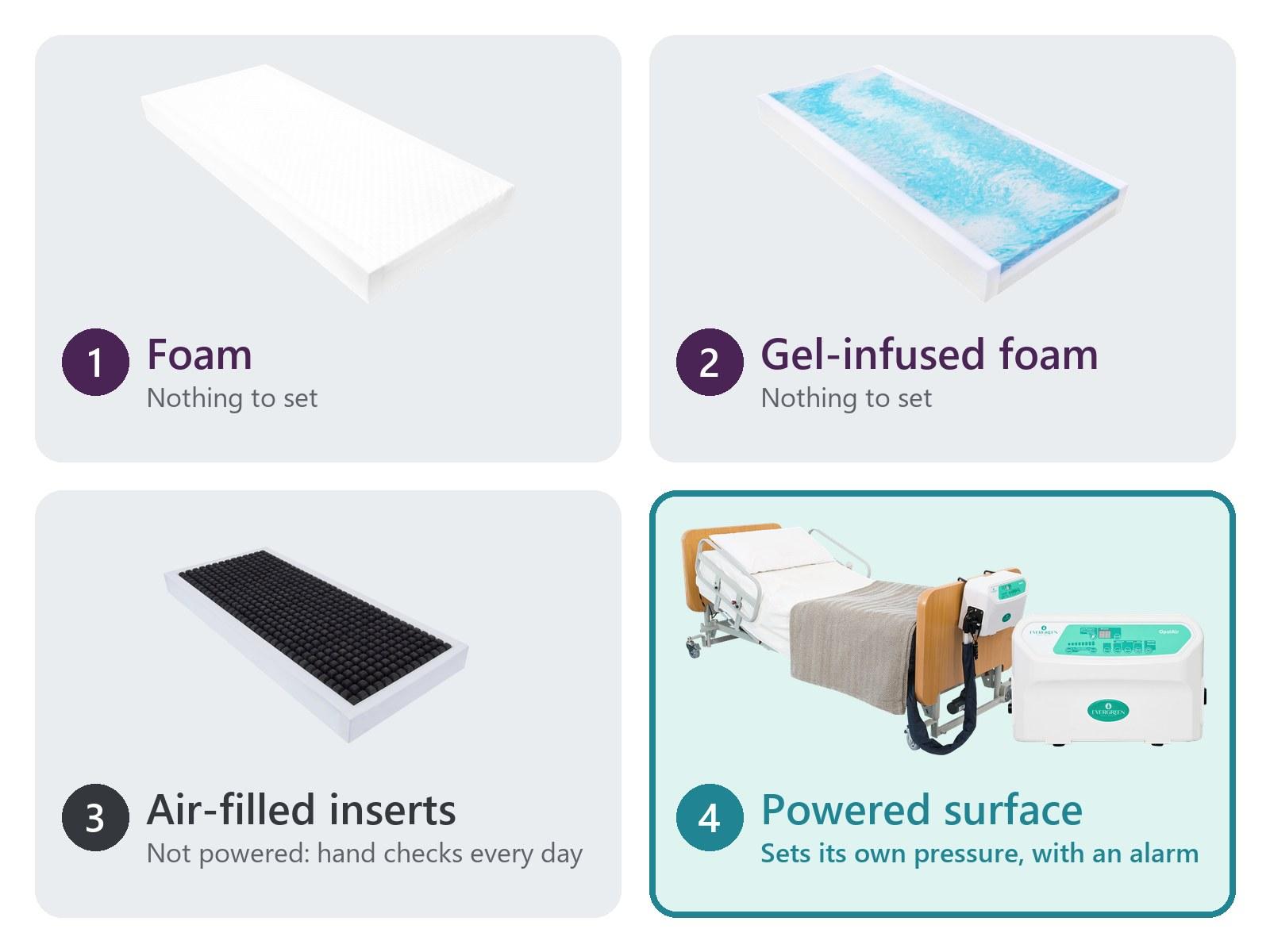
This guide explains the four types most teams meet: foam, gel-infused foam, non-powered air-filled inserts and overlays, and powered surfaces. It sets out the checks each one needs through the day, and when a powered-surface demonstration or trial is worth arranging.
A 30-second read
Clinical takeaways
Four types, three levels of staff work.
Foam and gel-infused foam need no setting. Air-filled inserts are not powered: they are set and checked by hand. Evergreen’s powered surfaces set their own pressure and run the therapy on their own. [1][3][5]
Non-powered air-filled inserts need hand checks every day.
One widely used manual requires a hand check of every section at least once a day, at every transfer onto the surface and after any pillow placement. No powered pump adds air when the head of the bed is raised, and no alarm signals a section that has lost air. The International Guideline’s expert and consumer panels flagged the risk of undetected deflation of reactive air surfaces. [2][3]
For Directors of Care: who does the hand check on nights and weekends, and where is it recorded?
Download the one-page handout on the four mattress types (PDF) to print for your unit or a purchasing meeting.
Section 1 · The terms
Four questions that sort out the terms.
- NPIAP S3I 2024 · Terms and definitions
Clinicians use support surface for a mattress designed to redistribute pressure. Pressure redistribution is the precise term for what many people call pressure relief. The National Pressure Injury Advisory Panel (NPIAP) keeps the standard vocabulary, and it separates four questions. [1]
| The question | What the terms mean |
|---|---|
| What is it made of? | Foam, air and gel are materials. A hybrid combines them. |
| How does it redistribute pressure? | A reactive surface changes only in response to the load on it. An active surface changes the load on its own. Alternating pressure is active. |
| Does it use electricity? | Powered or non-powered. A powered surface runs on electricity, usually through a powered pump. A non-powered surface uses none: foam, gel-infused foam, and air cells that staff inflate with a hand pump. A hand pump does not make a surface powered. A reactive surface can be powered: low air loss is an example. |
| What form does it take? | A mattress sits directly on the bed frame. An overlay is placed on top of an existing mattress. |
| How is the support described? | Immersion is how far the body sinks in. Envelopment is how closely the surface shapes around the body. Bottoming out is sinking so far that the surface no longer redistributes pressure. Microclimate is the temperature and humidity at the skin. |
Low air loss is a flow of air that assists pressure redistribution and may help manage heat and humidity at the skin. It is not another name for alternating pressure. One mattress can offer both. [1][2]
Foam · Section 2
Foam mattresses.
- Non-powered · reactive
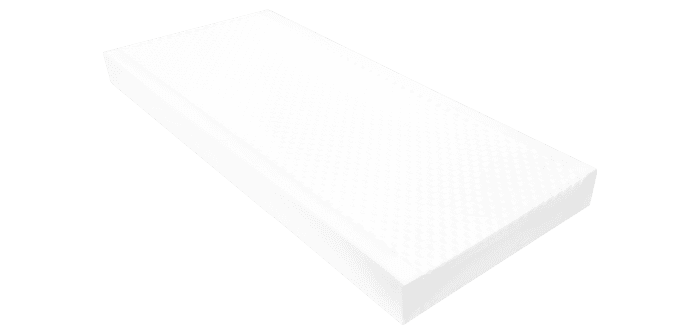
A pressure-redistribution foam mattress supports the body as the foam compresses under load. Some combine foam with gel, or have sections that can be swapped. Foam is non-powered and reactive, and it needs no setting: there is nothing for staff to inflate or adjust.
What to check: that the resident is comfortable, can move and transfer as intended, and is supported in the positions they use, and that the foam is still in good condition.
Gel-infused foam · Section 3
Gel-infused foam mattresses.
- Non-powered · reactive
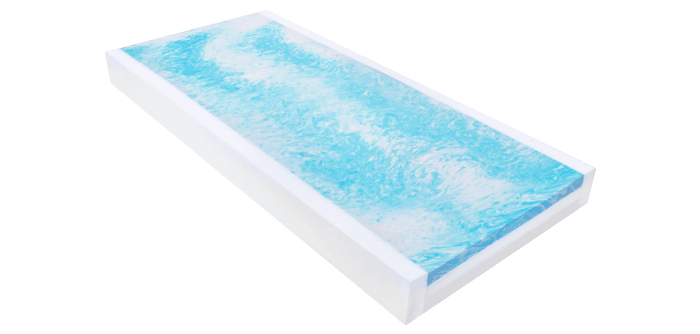
Gel-infused foam is memory foam with gel mixed into it. Evergreen describes its EverGel as breathable gel-infused memory foam, made for immersion, pressure distribution and heat dissipation. Like standard foam it is non-powered and reactive, with nothing for staff to inflate or adjust. [5]
What to check is the same as for foam: comfort, movement and transfers, support in the positions used, and the condition of the mattress.
Non-powered air-filled inserts · Section 4
Air-filled inserts and overlays: air, but not powered.
- Non-powered · reactive air
- Manufacturer’s operation manual, p. 5
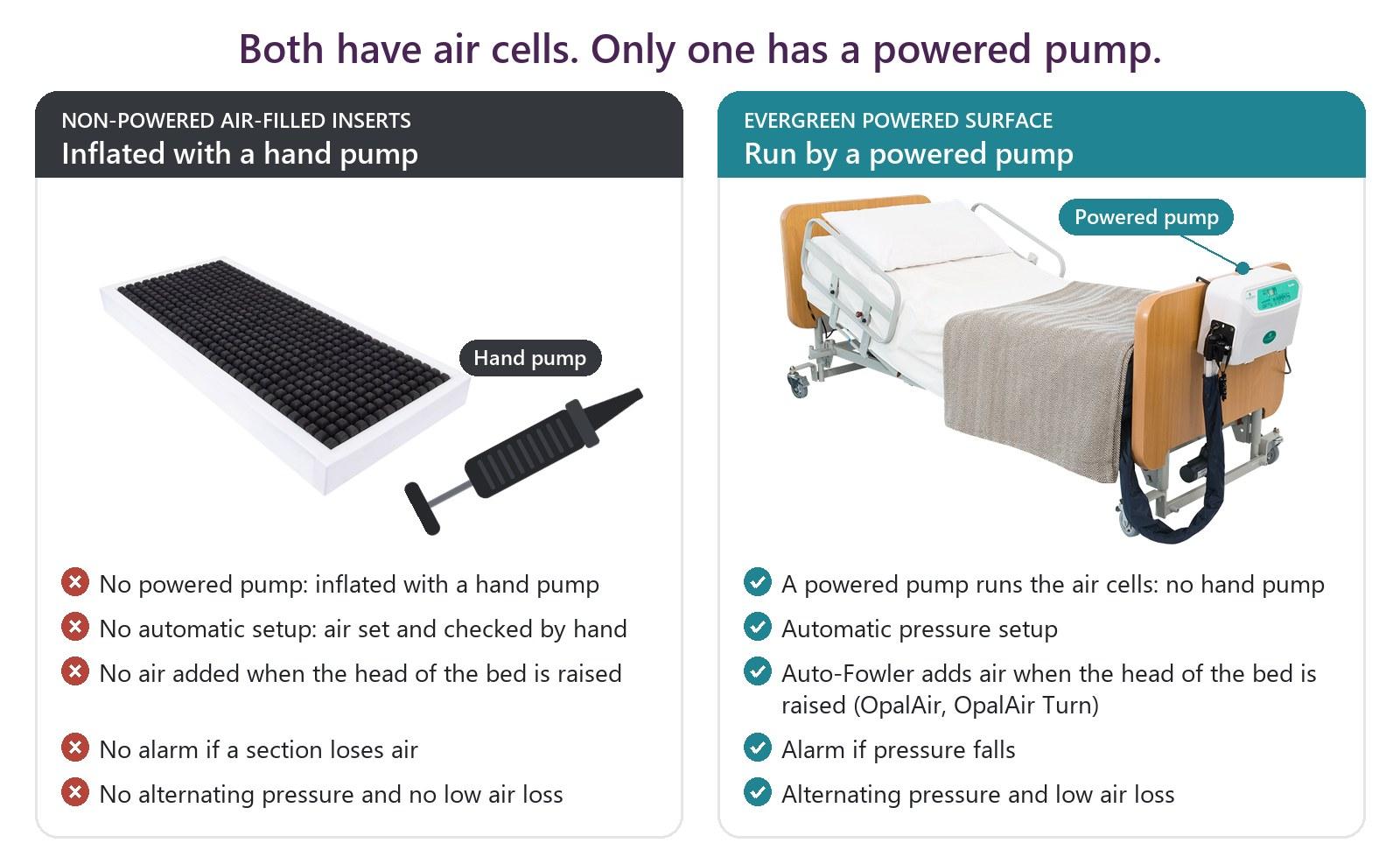
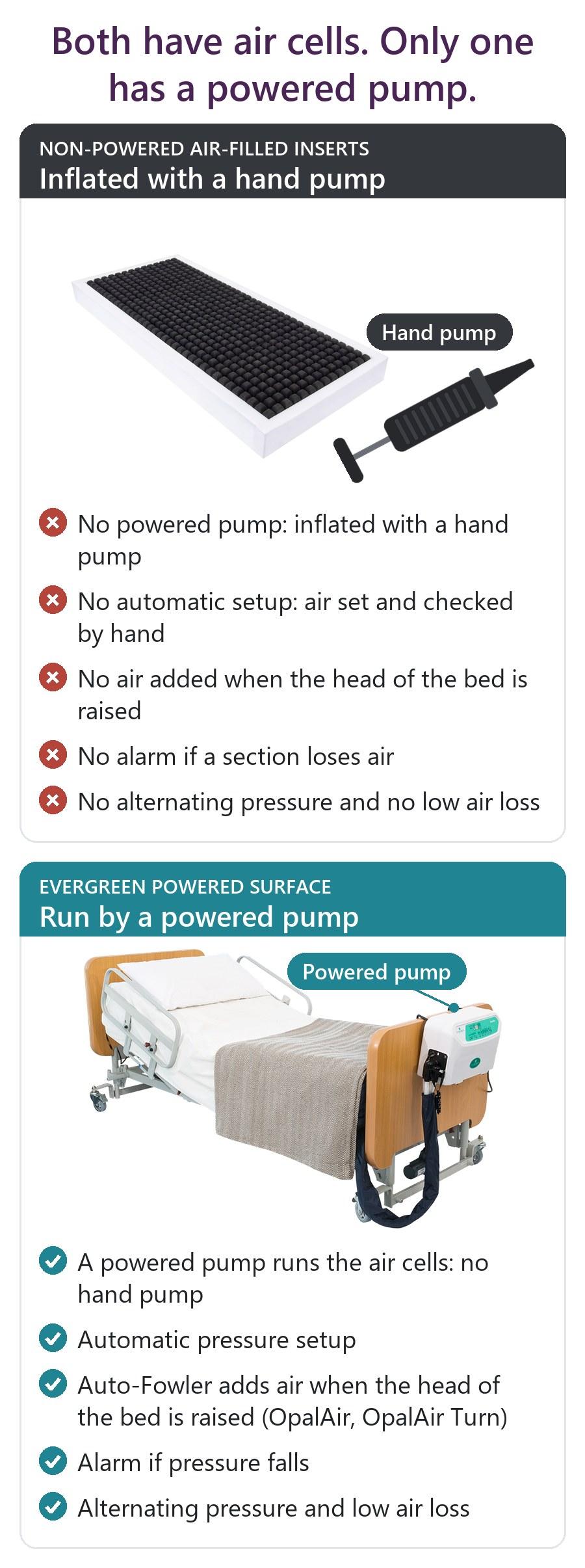
Non-powered air-filled inserts are often mistaken for powered air mattresses, because both have air cells. These are rows of small, connected air cells that staff inflate with a hand pump. Powered mattresses have air cells too, so the words “air cell” do not tell the two apart. What tells them apart is the pump: non-powered air-filled inserts have no powered pump, no power cord and no alarm. NPIAP’s terms for them are non-powered and reactive. [1] Used on top of a mattress they are sold as static air overlays or air-cell overlays. Fitted inside a foam mattress they are called inserts. Well-known examples include ROHO, Star and Waffle products.
The resident sinks into the hand-inflated cells (immersion), and the air spreads the load. The amount of air in each section is set by hand. Correct inflation is essential, and only a hand check confirms it: staff must complete every check the manufacturer requires to know that each section is still giving the intended support. With too little air the resident can bottom out, and nothing but a hand under the resident shows it. The manual for one widely used non-powered, hand-inflated air overlay shows what the checks take. [3]
Teams that use non-powered air-filled inserts will recognise the limits below. They are worth stating plainly whenever a surface is chosen or reviewed.
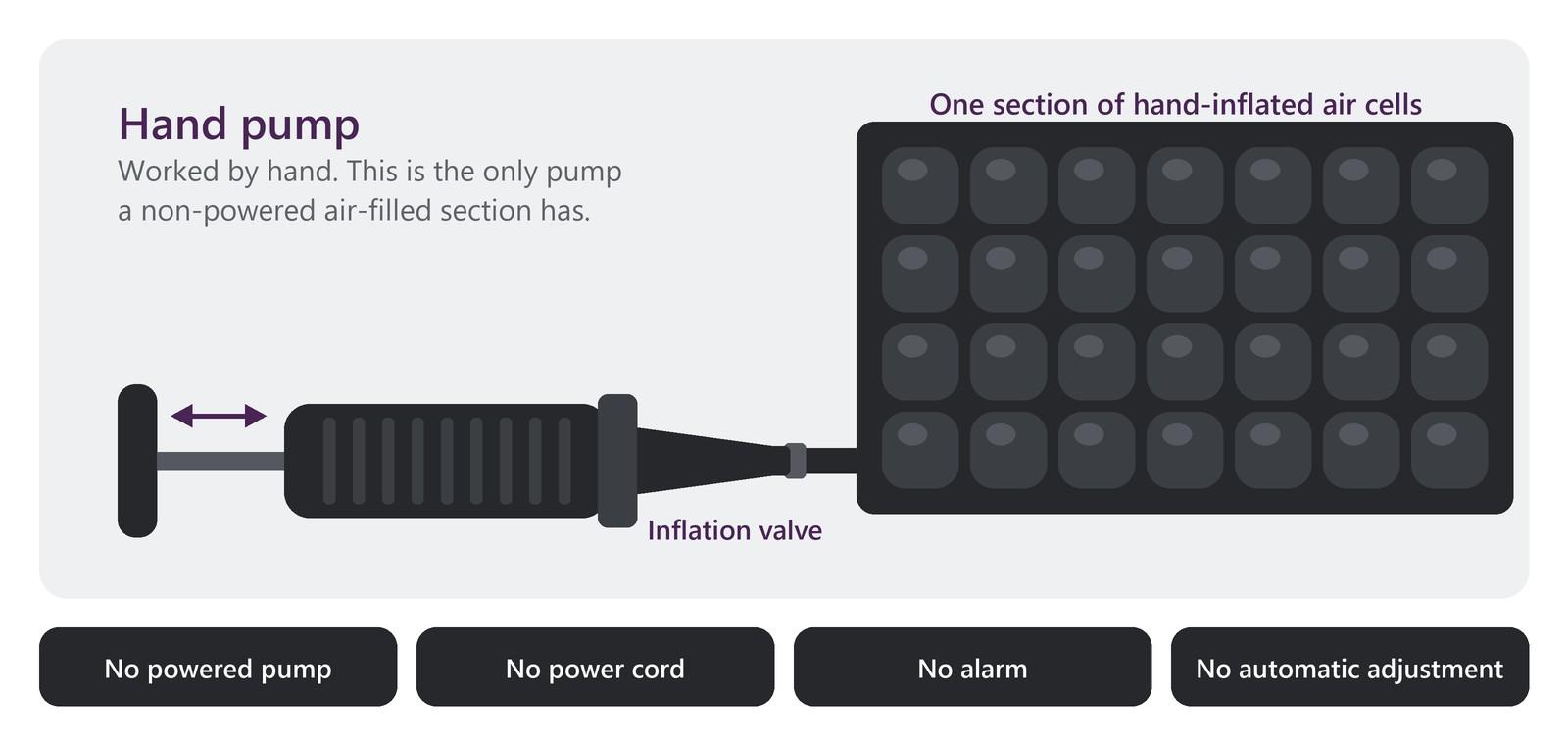
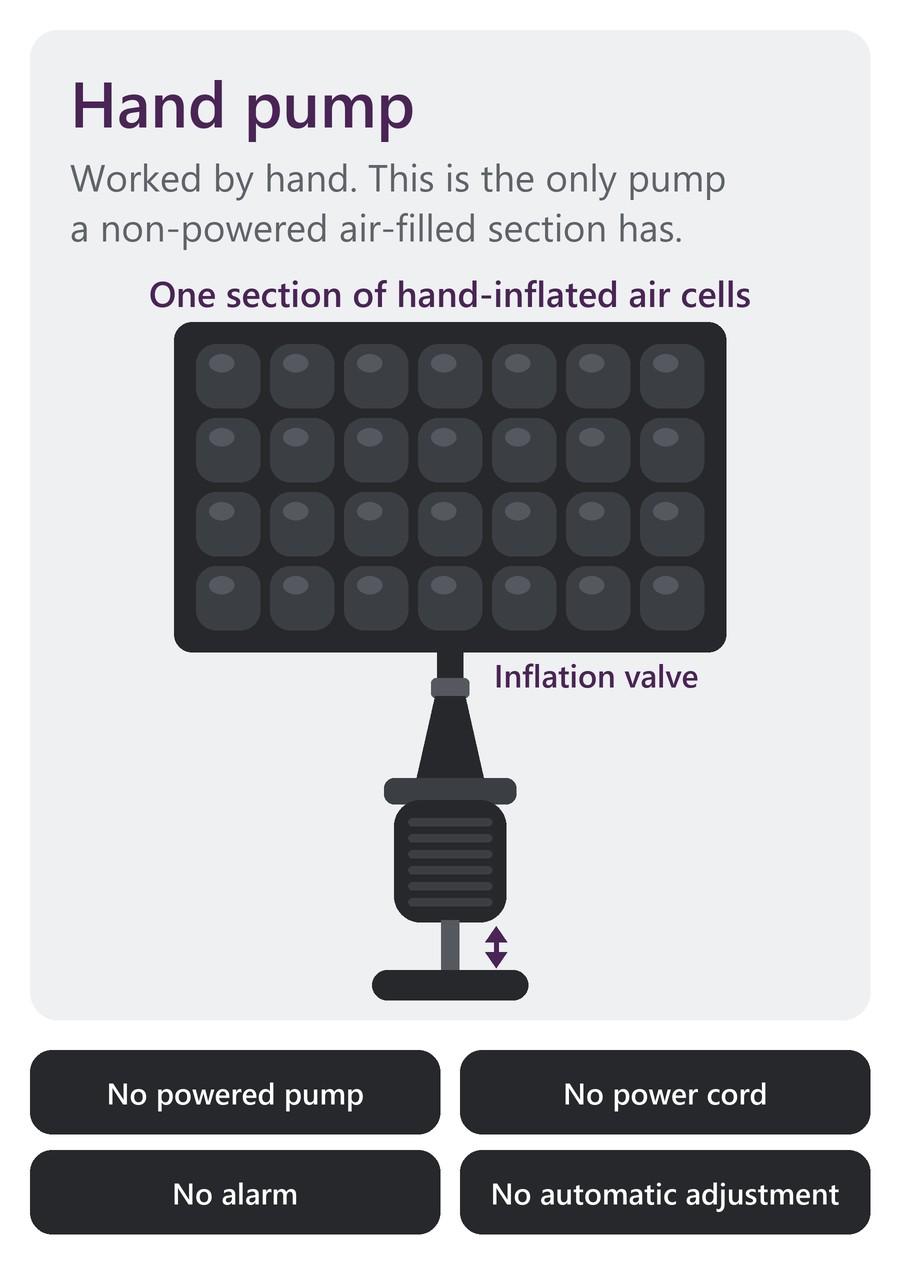
Here is what the cited manual asks staff to do. The first four steps inflate the sections. The last four adjust them to the resident, and they are repeated every time the resident transfers off the surface and back on. [3]
- 01With the bed flat, slide the hand pump nozzle over the section’s inflation valve and open the valve at least one full turn.
- 02Pump by hand until the section arches slightly or every air cell feels firm.
- 03Close the valve until it stops, remove the hand pump, and make sure the valve is closed.
- 04Repeat for every section. The standard system has four.
- 05The resident transfers on and lies in their usual position.
- 06Slide a hand between the surface and the resident and feel for the lowest bony prominence.
- 07Keeping the hand there, open the valve and let air out until the fingertips can barely move: about ½ to 1 inch (1.5 to 2.5 cm) from the base. Close the valve.
- 08Repeat the hand check for every section.
On a four-section system that is four valves and four hand checks, each with a hand under the resident: frequently and at least once a day, at every return to bed and after any pillow placement. Before each transfer the manual also has staff confirm that every section is inflated and that the overlay and mattress are flat. [3]
The manual gives no time for these steps. To see what they take on your unit, time one hand check, count how many are done for one resident in a day, and multiply.
The limits of non-powered air-filled inserts
What they don’t do
No powered pump means no automatic help
- No alternating pressure: the loaded areas stay the same until the resident moves or is repositioned.
- No low air loss: no powered airflow for heat and moisture at the skin. The International Guideline’s table of surface features marks microclimate management against low air loss, not against non-powered air. [2]
- No alarm: if a section loses air, nothing signals it.
- No air added when the head of the bed is raised.
What they need from staff · for the system in the cited manual
Everything is done by hand
- Set-up by the equipment provider or a clinician, and inflation with a compatible hand pump. [3]
- A hand check of every section: frequently and at least once a day, at every return to bed and after any pillow placement. [3]
- The right amount of air. The manual warns that with too much or too little, the benefit is reduced or lost and the resident may become unstable and at risk of falling. [3]
- Positioning pillows kept out from between the resident and the surface. [3]
- Care around sharp objects: punctures and tears are not covered by the warranty. [3]
Used as an overlay on top of a mattress, they also raise the lying surface, and the International Guideline warns that overlays can lift it to an unsafe level in relation to the side rails. [2]
When the cited manual requires a hand check
- Frequently, and at least once a day.
- Every time the resident transfers onto the surface, including leaving the bed and returning.
- After any positioning-pillow placement. Pillows go under the overlay, not between the resident and the surface.
- For every section, each time. The check is a hand under the resident’s lowest bony point, not a glance at the mattress: the manual notes that an unoccupied section can look under-inflated even when it is correctly adjusted.
These are one product’s instructions, not rules for every non-powered air-filled product. Use the instructions supplied with the exact insert and mattress. [3]
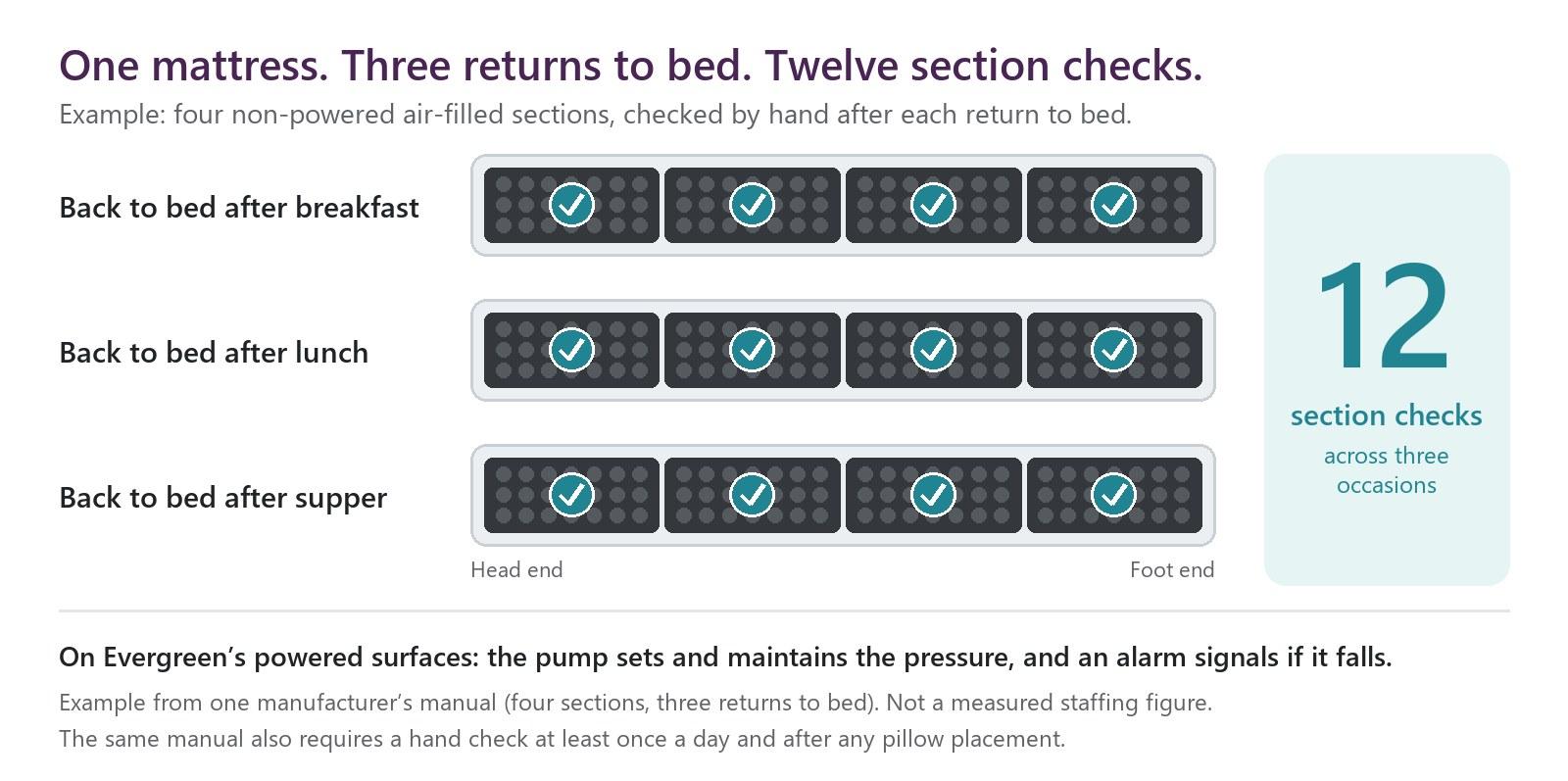
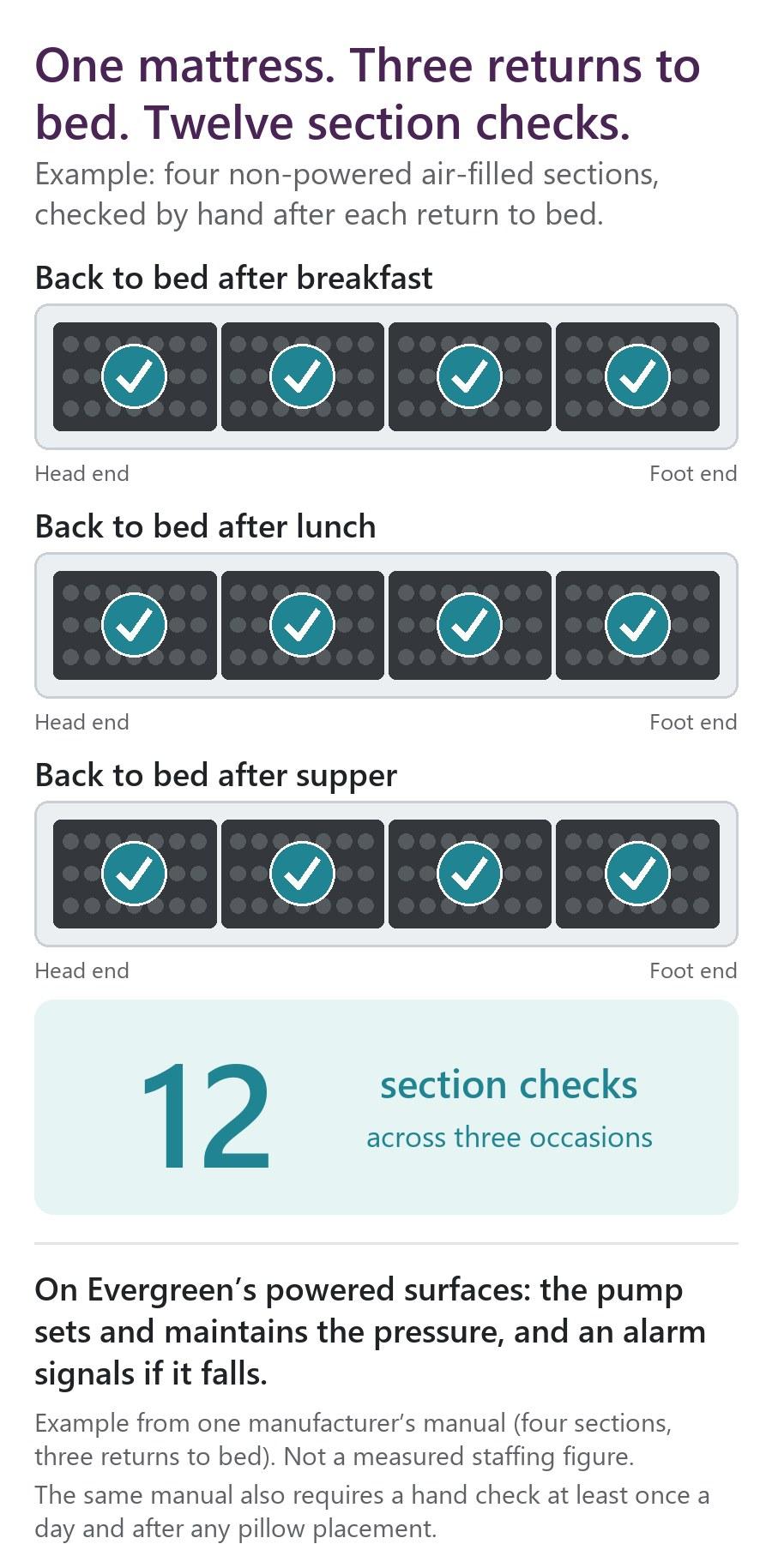
Can your care team reliably complete the required checks?
For the system described here, the hand checks are part of using the equipment correctly, not an optional extra. Name who checks each section, when, and what happens when something is wrong. A check that is not recorded cannot be shown to have been done.
If that routine can’t be delivered every day and on every return to bed, reassess the equipment and the care plan. A demonstration of an Evergreen powered surface shows how automatic pressure setup, alternating pressure and a low-pressure alarm could fit the resident’s or client’s needs. Daily equipment checks, skin assessment and repositioning continue.
Five questions for a unit using non-powered air-filled inserts
- Who does the hand check of every section, every day and at every return to bed, including nights and weekends?
- Is everyone who returns a resident to bed trained to do the hand check and use the hand pump?
- Where are the hand pump and repair kit kept?
- How long does one hand check take, and how many are done each day? Time one, count them for one resident, and multiply.
- Where is each check recorded, and what happens when a section has lost air?
The cited manual says the product should be set up by the equipment provider or a clinician, and supplies a hand pump and repair kit with it. [3]
When the head of the bed is raised
Non-powered air-filled inserts have no powered pump to add air when the head of the bed goes up, or to take it out when it comes back down. Their hand-inflated cells respond to the resident’s weight, but the amount of air stays as it was set by hand.
Before each transfer, the cited manual has staff confirm that the overlay and the bed mattress are flat. It lists no separate check for a change in bed position, so follow the instructions for the product you use. Without an automatic adjustment, a hand check is how staff confirm the support in the positions the resident uses. When the head of the bed has to be raised for a clinical reason, the International Guideline advises re-evaluating the surface. [2][3]
…risk of undetected deflation of air (reactive) surfaces that can lead to a PI.
Expert and Consumer Panel Groups · International Guideline, 4th ed. · Full Body Support Surfaces · 2026, p. 8 [2]
Powered surfaces · Section 5
Powered surfaces: automatic setup and ongoing therapy.
- Powered · alternating pressure is active
- Evergreen product information
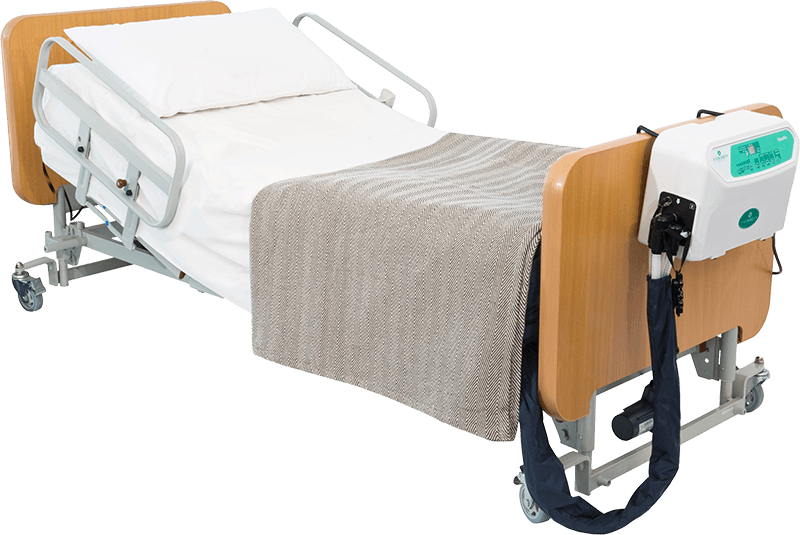
Powered support surfaces use electrical energy to operate. Evergreen’s powered range consists of replacement air mattresses connected to a powered pump at the foot of the bed. Depending on the model, the pump provides alternating pressure, low air loss or both. Alternating pressure changes which cells carry the load through a repeating cycle, so the loaded areas keep changing even when the resident cannot move. Low air loss uses a flow of air to help manage heat and humidity at the skin, the microclimate, which no non-powered surface in this guide does. The International Guideline suggests low air loss for people at risk when heat and moisture at the skin contribute (SS11). [1][2] More in Low Air Loss Mattresses: Heat, Moisture and Skin.
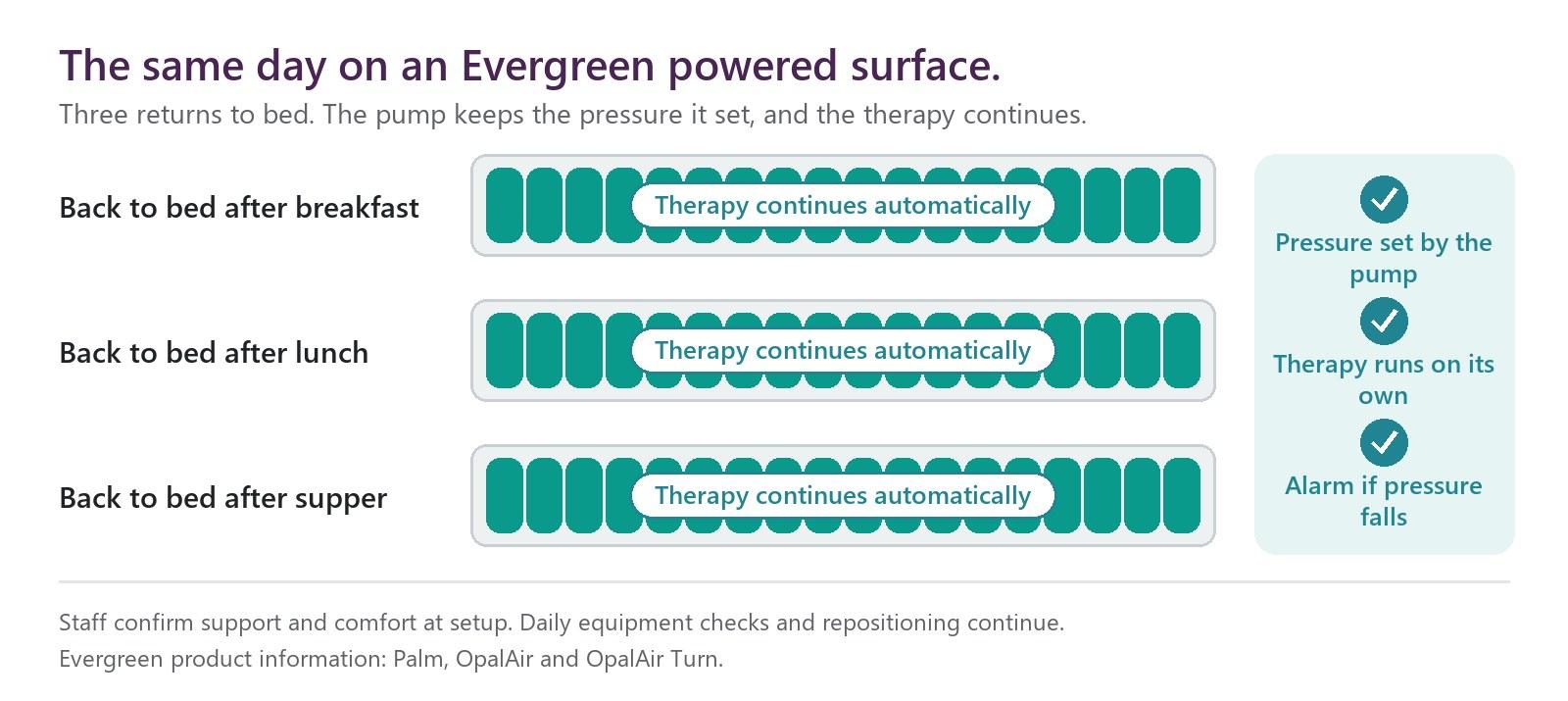
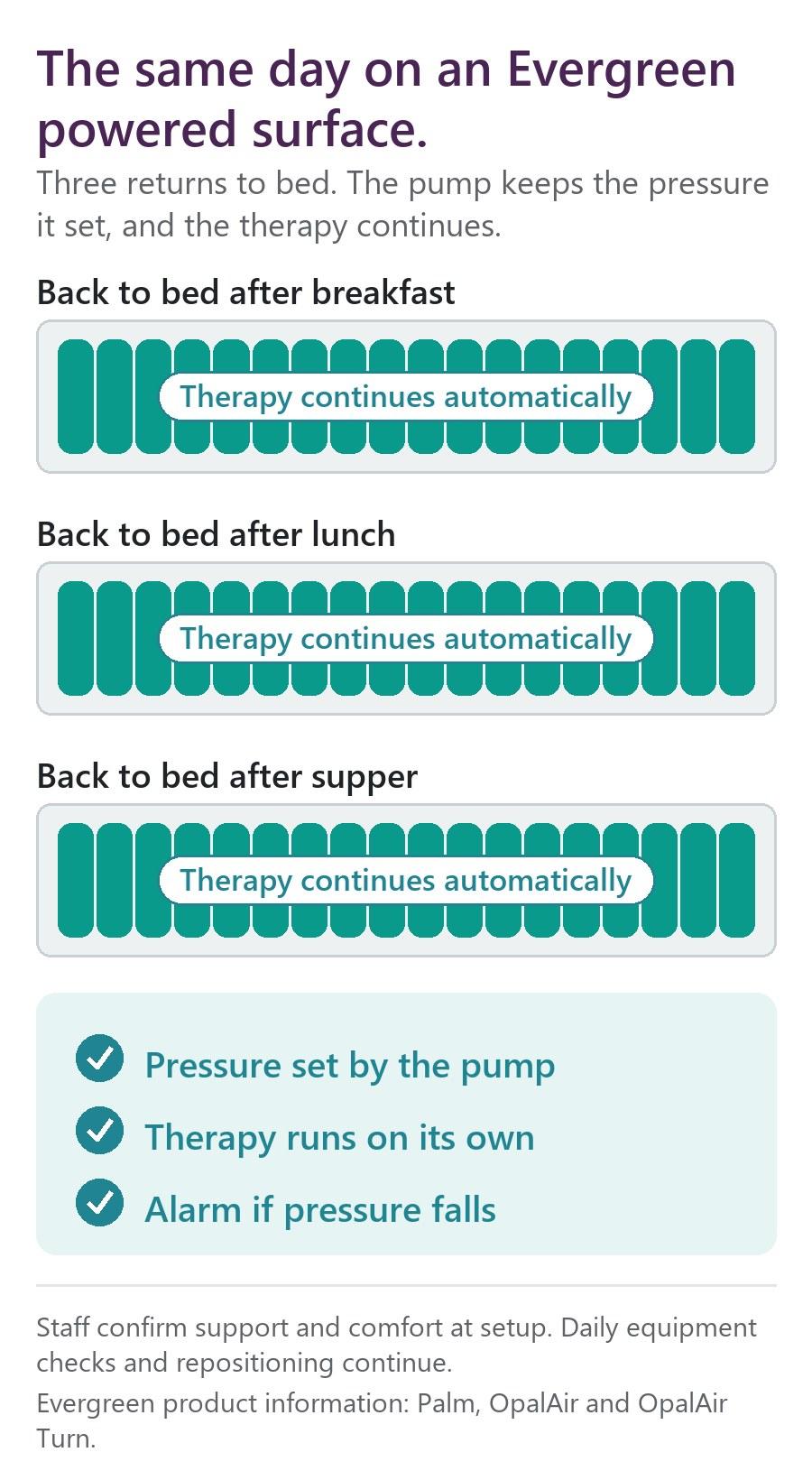
The practical difference from non-powered air-filled inserts is who does the work. With non-powered inserts, staff set and check the air by hand. On Evergreen’s powered surfaces, Auto-Detect sets the starting pressure automatically and the pump runs the selected therapy. Staff continue equipment checks and their assessment of support and comfort.
On Evergreen’s powered surfaces
Setup is simple.
Auto-Detect sets the resident’s starting pressure automatically, based on bodyweight and surface area. Staff confirm support and comfort. (Palm, OpalAir and OpalAir Turn.)
The therapy runs on its own.
Once set up, the selected therapy mode continues automatically, reducing the need for routine manual adjustments.
It responds when the head of the bed is raised.
Auto-Fowler, on OpalAir and OpalAir Turn: when the head of the bed is raised, the pump automatically increases air pressure in the cells to protect against bottoming-out. When the head of the bed is lowered, the system returns to the previous setting, without anyone touching the pump.
It tells you if pressure falls.
An audible and visual alarm signals abnormally low pressure, and a separate alarm signals a power failure.
It firms up for care, then goes back.
Auto-Firm fully inflates the cells for repositioning, transfers or personal care, then returns to the previous therapy mode on its own after twenty minutes.
Every support surface is still inspected at least daily, and repositioning continues. [2] See both in two short films: Evergreen Powered Surfaces: How They Work and Powered Surfaces for Everyday Long-Term Care.
Side by side · Section 6
Side by side: non-powered air-filled inserts and powered surfaces.
- Manufacturers’ instructions
- Illustrative purchase prices · 19 November 2026
The two are easy to confuse, because both contain air. Here they are together: how each redistributes pressure, what each asks of staff through the day, and what each costs to buy.
| Through the day | Non-powered air-filled inserts | Evergreen powered surface |
|---|---|---|
| Changing the loaded areas | No powered alternating cycle | Alternating pressure |
| Setting the pressure | By hand, each section | Auto-Detect sets it |
| After a return to bed | Hand check, every section | Therapy continues automatically |
| Head of the bed raised | No air added | Auto-Fowler adds air (OpalAir, OpalAir Turn) |
| If pressure falls | No alarm | Audible and visual alarm |
| Heat and moisture | No powered airflow | Low air loss |
| Daily equipment check | Yes | Yes |
Insert column: the cited manual. [3] Powered column: Evergreen product information and manuals. [5]
Purchase price
What each complete setup costs
| Illustrative setup | Purchase price, CAD |
|---|---|
| Evolve + four non-powered air-filled sections | $5,683 |
| Evolve + two non-powered air-filled sections + two foam inserts | $3,539 |
| Palm, 36-inch: alternating pressure + micro low air loss | $2,999 MSRP |
| OpalAir, 36-inch: alternating pressure + true low air loss | $6,699 MSRP |
Prices checked 19 November 2026. Non-powered air-filled sections at $1,171 each, a Canadian retailer’s advertised price. Evolve ($999), foam inserts ($99 each), Palm and OpalAir at Evergreen MSRP. These are purchase prices, not matched quotes or lifetime costs, and they say nothing about clinical results. Ask for a complete quote for the setup you need. [6]
Non-powered air-filled sections are usually priced one at a time, and they need a mattress to hold them. At the illustrative prices above, both Evolve configurations cost more to purchase than the 36-inch Palm, a powered surface with alternating pressure and low air loss.
For the unit or a purchasing meeting, print the one-page comparison of the four mattress types.
Section 7 · When to trial powered
When a powered surface is worth a trial.
- SS11 · Guideline recommendation
- Randomized trial · alternating pressure vs foam
When to consider a powered surface
Seven signs to consider a powered surface in long-term care
Any one of these signs is a reason to assess whether a powered surface could better meet the resident’s needs.
Thinking of a resident? Tap the signs they show.
Also consider changing the surface when a resident with an existing pressure injury is uncomfortable or bottoming out on it (Guideline SS12).
PRESSURE 2 signs are the trial authors’ advice. The guideline suggests low air loss for Stage 2–4 or unstageable injuries (SS15), and that it could be used for people at risk, “especially when moisture and heat at the skin-surface interface are contributing factors” (SS11).
Sauvage et al., 2017 · Nixon et al., PRESSURE 2, 2019 · International Guideline (EPUAP/NPIAP/PPPIA), 2026 · BC PISWC mattress algorithm, 2026 · PRESSURE 2 ↗ · Sauvage 2017 ↗ · Guideline ↗ · BC algorithm ↗
The resident can’t reposition, and time in bed is growing.
Alternating pressure adds active pressure redistribution between assisted position changes. Example: a resident who now depends on staff for every position change and spends more of the day in bed.
Heat or moisture at the skin.
The International Guideline suggests low air loss could be used for people at risk, especially when heat and moisture at the skin–surface interface contribute (SS11). Skin and continence care continue alongside. [2]
The checking routine can’t be kept up.
If a hand check of every section, every day and at every return to bed, is not realistic on the unit or at home, a surface that sets its own pressure and alarms when it falls is worth seeing.
The head of the bed is raised for much of the day.
Example: a community client who uses an adjustable bed in several positions. Automatic adjustment can be demonstrated to the caregiver in those positions.
Sauvage et al., 2017 · Randomized trial · France
2 of 39 vs 13 of 37
Residents with a new pressure injury within 30 days · alternating-pressure air mattress vs viscoelastic foam
- Residents
- 76 people aged 70 or older in nine French medium- and long-stay facilities, in bed at least 15 hours a day with little or no ability to reposition themselves.
- Finding
- New pressure injuries, including Stage 1, developed in 2 of 39 residents on alternating pressure versus 13 of 37 on viscoelastic foam. Preventive care was similar in both groups.
Sauvage et al., Journal of Wound Care 2017 [4]
The trial compared alternating pressure with foam, using another manufacturer’s mattress. It is the research behind alternating pressure, not a comparison with non-powered air-filled inserts.
From Evergreen
Turn a demonstration into a useful trial.
- Evergreen product information
Evergreen offers all four types: EverFoam, EverGel (gel-infused memory foam), Evolve, a foam mattress with four insert regions that accept foam, gel or non-powered air-filled inserts, and three powered surfaces. Palm combines alternating pressure with micro low air loss. OpalAir and OpalAir Turn combine alternating pressure with true low air loss, and OpalAir Turn adds lateral rotation. [5]
Before a trial, agree
Bring one resident or client, and one care question
- The need, and the reason for trying a different surface.
- The bed, bedding, transfer equipment and positioning supports to use with it.
- Who learns the controls, does the daily equipment check and responds to an alarm.
- What to record: skin, comfort, movement and transfers, and the adjustments staff or caregivers actually make.
- A review date, and the clinician who will assess the result.
Long-term care
A question for the unit
Could automatic pressure setup and alternating pressure better fit this resident’s needs and the unit’s care routine?
Community
A question for home
Can the client’s caregivers complete the hand checks the product requires, every day, and would automatic adjustment help?
Questions people ask
See it at the bedside
Have a resident or client whose mattress no longer meets their needs?
Book a demonstration and we’ll walk your team through alternating pressure, low air loss and automatic adjustment, then talk through a trial around that person’s needs.
Or print the one-page comparison · read the Selection Guide.
About Evergreen. An Evergreen educational summary of published terminology, guidelines, a clinical study and manufacturers’ instructions. The sources do not endorse Evergreen or its products. Brand names belong to their owners; the manual cited describes another manufacturer’s product, so follow the instructions for the product you use. Support surfaces do not replace repositioning. Selection and use should be based on individual clinical assessment and the product instructions for use.
Explore Evergreen’s surfaces.
These links describe Evergreen’s range. They are not study endorsements or product-specific evidence.
EverFoam
Pressure-redistribution foam mattress
View product →
EverGel
Gel-infused memory foam mattress
View product →
Evolve
Foam mattress with insert regions for foam, gel or non-powered air-filled inserts
View product →
Palm
Alternating pressure with micro low air loss
View product →
OpalAir
Alternating pressure with true low air loss
View product →
OpalAir Turn
Those functions plus lateral rotation
View product →
References
- National Pressure Injury Advisory Panel, Support Surface Standards Initiative. Terms and Definitions Related to Support Surfaces, rev. 18 April 2024; Low Air Loss Terminology Position Statement, 2024. https://npiap.com/page/S3I
- National Pressure Injury Advisory Panel, European Pressure Ulcer Advisory Panel, Pan Pacific Pressure Injury Alliance. Full Body Support Surfaces (version date 20 May 2026: daily inspection and overlays and side rails, p. 3; Table 3, p. 7; expert and consumer panels, p. 8; SS11, p. 13) and Repositioning and Mobilization (version date 14 May 2026: R1, p. 1; R11, p. 13). In: The International Guideline. 4th ed. 2026. https://www.internationalguideline.com
- ROHO, Inc. (Permobil). ROHO DRY FLOATATION Mattress Overlay Operation Manual. T20265, revision 2024-02-22. Printed pp. 2–6. Use the instructions supplied for the exact insert and mattress.
- Sauvage P, Touflet M, Pradere C, et al. Pressure ulcers prevention efficacy of an alternating pressure air mattress in elderly patients: E²MAO a randomised study. J Wound Care. 2017;26(6):304–312. doi:10.12968/jowc.2017.26.6.304. Table 5, p. 310.
- Evergreen Medical Products. Palm, OpalAir and OpalAir Turn product pages and user manuals: Auto-Detect, Auto-Fowler, Auto-Firm and audiovisual alarms. evergreenmedicalproducts.com/guides
- Illustrative pricing: $1,171 per 19 × 30 non-powered air-filled section, a Canadian retailer’s advertised online price; Evolve, EverFoam insert, Palm and OpalAir MSRP from evergreenmedicalproducts.com. All checked 19 November 2026. Not a universal price or a quotation.
Continue the clinical pathway
This article is an educational resource for healthcare professionals and reflects Evergreen’s interpretation of the cited studies and guidelines; read the original sources for full methods and results. It is not intended to replace clinical judgment, individualized resident assessment, facility policy, or product instructions for use.