Pressure redistribution
Why alternating pressure?
Groups of air cells gently deflate and refill in turn, changing which parts of the body take the weight.
Now accepting November 2026 in-service requests: virtual across Canada, in person where scheduling allows. Now accepting November in-service requests. Request an in-service →
For families and caregivers
Pressure injuries (also called bedsores or pressure ulcers) are damage to the skin and the tissue underneath, usually over a bony area. They can develop when someone stays in one position for a long time, and they can be painful. A powered air mattress is one thing a clinician may recommend.
Any one of these is a reason to ask whether the mattress they have now is still right, and whether a powered mattress could help. The person you care for:
Many things affect skin health, and the mattress is one of them. Needs also change over time, so a mattress that was right before may not be the right one now. Tell the care team about any changes you have noticed, and ask whether the mattress should be reassessed.
A new red, purple or dark patch of skin, a blister or broken skin? Tell the nurse or doctor straight away. Do not wait to see if it fades.
If the person lives in long-term care, start with the care team. Ask how mattresses are assessed and supplied, and whether a reassessment would help.
The research on when to consider a powered mattress is on our site, written for long-term care clinicians: the seven signs to consider a powered surface.
Pressure redistribution
Groups of air cells gently deflate and refill in turn, changing which parts of the body take the weight.
Skin protection
Air flows under the cover and helps manage heat and moisture at the skin.
Animation sped up for illustration. Actual cell movement is much slower.
Watch the feature animations →Request a demonstration or discuss a trial →
Here are features to discuss with your clinician. Palm, OpalAir and OpalAir Turn share the first three. The heel feature is on OpalAir and OpalAir Turn.
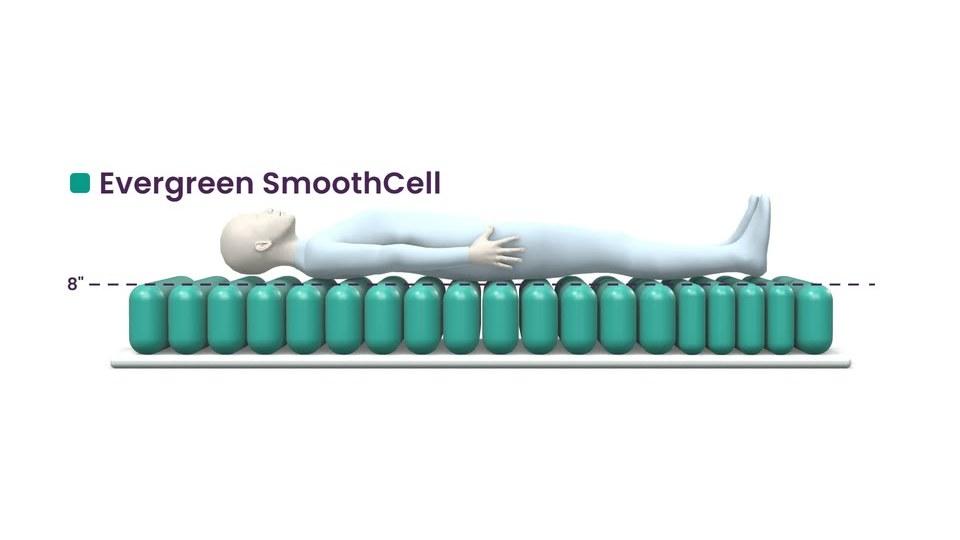
Each set of air cells refills before the next set deflates. This helps keep the person at a steady height as the mattress cycles. We call this SmoothCell.
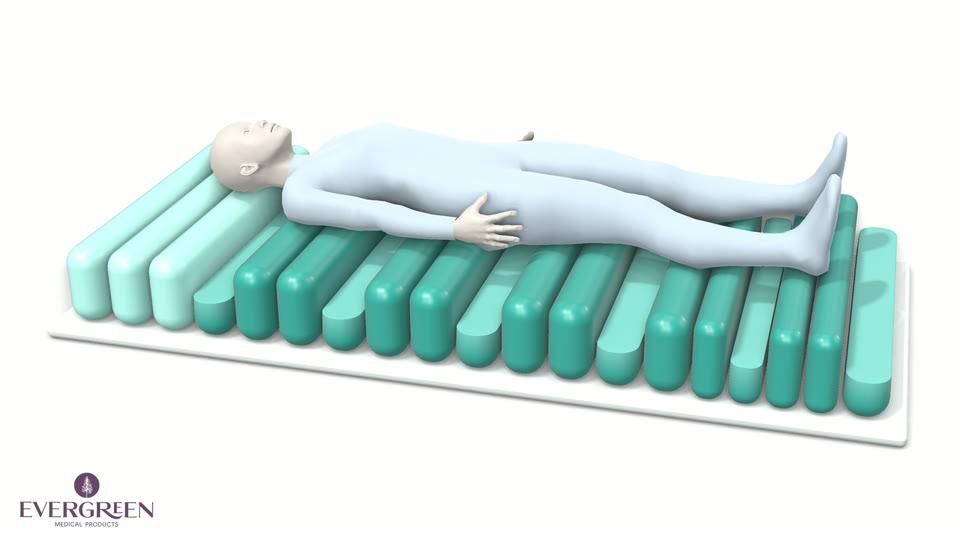
The three air cells under the head stay inflated while the body cells alternate. We call this StaticPillow.
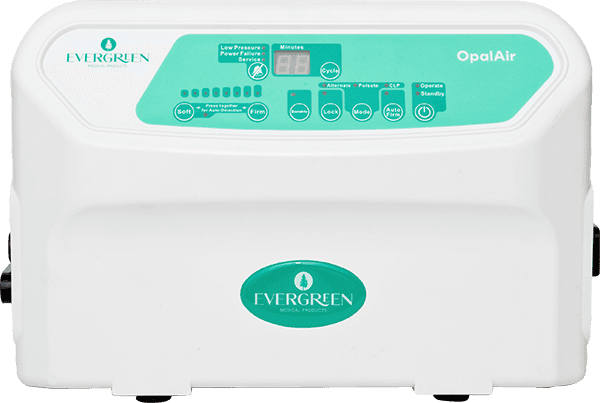
The pump sets the starting air pressure automatically, based on body weight, which makes set-up simpler. We call this Auto-Detect. Your care team still checks support and comfort.
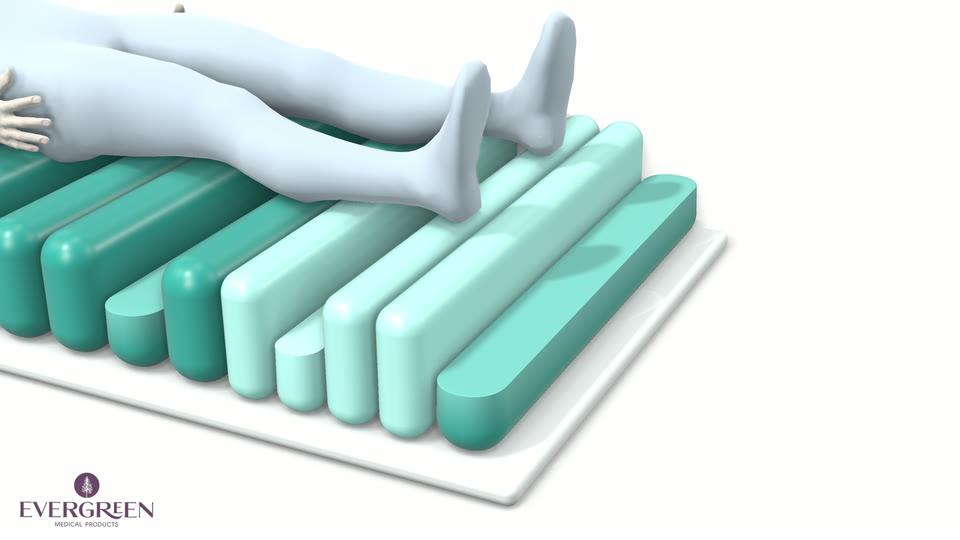
On OpalAir and OpalAir Turn, slimmer air cells let the heels settle more deeply into the mattress. We call this HeelOffload. It is not the same as lifting the heels clear of the mattress, so your clinician decides whether separate heel support is needed.
Your clinician considers skin condition, movement, comfort, body size and care needs when choosing a mattress.
 PalmAlternating pressure with micro low air loss, a lower flow of air.
 OpalAirAlternating pressure with true low air loss, which moves more air.
 OpalAir TurnAlso has a setting that slowly tilts the surface from side to side (clinicians call this lateral rotation). Your care team decides whether and how to use it.
Ask your clinician: “Would an Evergreen Palm, OpalAir or OpalAir Turn suit their needs? Could a demonstration or trial help us decide?”
Print it, or send the link.
An occupational therapist, physiotherapist or nurse assesses the person and decides whether a powered mattress is right.
Let us know, and we will introduce you to an Evergreen dealer in your area, where there is one. The dealer arranges it and confirms price, delivery, set-up and service.
Not sure who to ask? Start with your usual healthcare professional or your local home and community care service, and ask how to arrange an equipment assessment.
Before you pay, check health benefits covering the person who needs the equipment, including any partner’s plan, and relevant provincial or territorial programs.
We aim to reply within 10 business days.
For equipment service or repairs, contact the supplier or care home that provided it. For urgent health concerns, seek medical help. Do not wait for a reply from Evergreen.